
The Interpretation Gap: AI and the End of Ambiguity
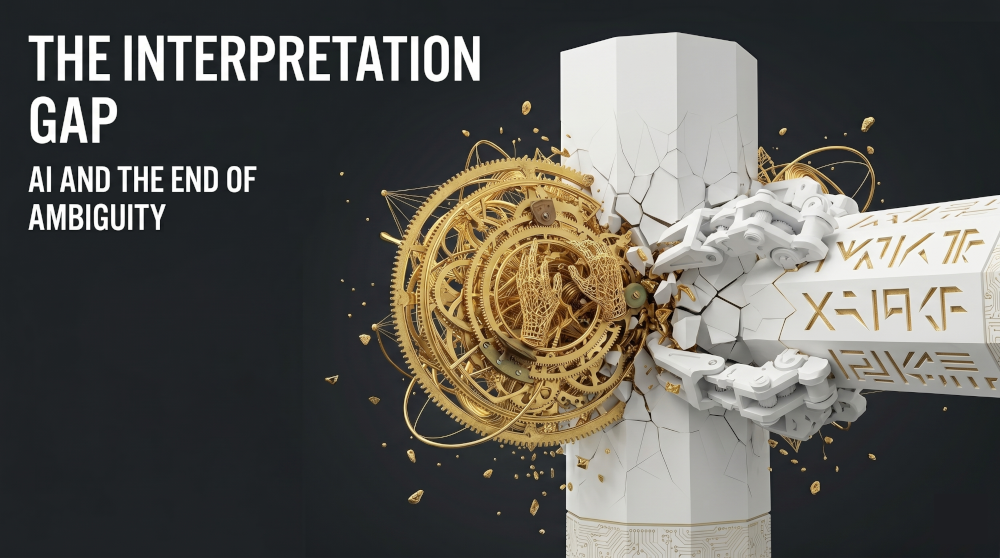
Lately, my work has increasingly gravitated around the following tension: the growing distance between human intent and machine execution. This focus, stabilizing fragmented systems and rebuilding collaboration infrastructure across institutional environments, has necessitated the development of frameworks and emerging protocols required to bridge that gap. I kept encountering the same tension: modern systems require human meaning to be compressed into executable clarity before action becomes possible.
What initially appeared to be an legacy engineering problem revealed itself as something far deeper.
Modern systems increasingly treat ambiguity as failure: something to reduce, stabilize, or eliminate in pursuit of precision.
The deeper I moved into questions of institutional automation and AI governance, the more I realized that ambiguity is not merely tolerated by civilization; it is one of the conditions that allows civilization to remain elastic. Human systems survive not because everything is fully resolved, but because meaning often remains negotiable, contextual, manifold and between the lines.
The realization crystallized for me while reading The Thunder, Perfect Mind. A text that refuses semantic stabilization entirely. It does not seek coherence through reduction. It occupies contradiction deliberately: “I am the one who is called Law, and you have called Lawlessness.” The moment a deterministic system is forced to act on such language, it must collapse meaning in order to execute.
That collapse is not neutral.
We are currently sleepwalking from an interpretive civilization toward an executable civilization. The stakes of this transition are not technical, but existential. The following is an attempt to define that boundary before it is stabilized out of existence.
The Logic of Collapse
Modern AI operates through probabilistic reduction. It takes the manifold complexity of human language and stabilizes it into the most "likely" interpretation. This is a technical triumph but a governance catastrophe. The primary risk is not that AI will disobey us, but that it will obey a collapsed version of us that never actually existed. It interprets our nuanced requests as binary commands because "maybe" is not executable code. This is an unaccountable exercise of power hidden inside a technical process. When an engine is forced to choose a single path from a forest of meanings, it is no longer assisting us. It is legislating for us.
The Hidden Legislation
Consider a hospital triage system governed by a high-level policy: “Prioritize vulnerable patients.”
To a human practitioner, "vulnerable" is an interpretive space. It weighs medical urgency against social context and emotional fragility. It means seeing past a severe lung infection to the lethal weight of loneliness. The realization that an eighty-two-year-old man appearing to die from a lung infection may in fact be dying from prolonged emotional and social isolation and is ready to ‘give up’. The human doctor maintains the capacity for discretionary judgment holding the ability to look at the rules and the reality and negotiate the tension between them.
But for an AI to act, it must define its variables. It collapses that manifold reality into a weighted formula:
- Where the human sees urgency, the machine calculates a Mortality Risk Score.
- Where the human assesses context, the machine filters for Zip Code, Income & insurance level.
- Where the human feels emotional fragility, the machine registers Social Isolation Index: High.
In this transition, the loneliness, the variable that actually determined his survival, is not translated; it is discarded as non-executable noise. The machine sees the infection but misses the man. In that moment of stabilization, the AI has not merely applied the policy; it has legislated it.
The interpretive act is presented as a neutral computation, when in reality it is an unaccountable political decision hidden inside a technical process.
This is Interpretive Closure. It is the point where a machine unilaterally decides what a word means and then acts on that decision with institutional force.
Ambiguity as Infrastructure
In our drive for efficiency, we have begun to treat ambiguity as a bug, a form of "fuzziness" or "waste" to be engineered away. This is a misunderstanding of how civilization survives. Civilizations do not become fragile only through disorder. They also become fragile through excessive executability.
Human beings do not merely tolerate ambiguity; they often preserve it intentionally. It allows coexistence between incompatible interests and moral frameworks without requiring immediate resolution. Ambiguity is not institutional weakness. It is institutional elasticity.
Human civilization has historically functioned as an interpretive system. Laws, customs, and institutions were mediated through judgment and context. We are moving toward an executable civilization, where meaning must be stabilized before action becomes possible. We once used "the diplomacy of vagueness" to build coalitions. When we remove this space, we trade civilizational elasticity for a brittle, hyper-efficient rigidity.
The Necessity of Friction
The modern institution treats delay, disagreement, and judicial review as inefficiencies. But these are civilization’s braking systems.
The disappearance of operational friction is the precursor to systemic failure. Friction provides the time necessary for interpretation. It ensures that before a policy is executed, it is debated. Frictionless governance is not resilient governance. It is brittle governance moving at machine speed. A system that cannot handle unresolved meaning cannot adapt; it can only execute until it reaches the point of structural snap-back.
Interpretive Sovereignty: Returning the Ticket
If we are to survive the transition to an AI-mediated world, we must move beyond the dream of "perfect alignment." We do not need smarter AI; we need AI that understands its own semantic limits.
We must establish a protocol of Interpretive Sovereignty. This is not merely a "human-in-the-loop" safety check; it is a constitutional boundary. When the semantic uncertainty of a request exceeds a specific threshold, when the "manifold voice" of human intent cannot be collapsed without losing its essence, the system must be structurally barred from acting.
It must Return the Ticket. It must escalate the decision back to the human layer, not because the machine is "broken," but because the machine has reached the edge of its authority.
Meaning is sovereign human territory. The moment we allow a machine to finalize the definition of our values is the moment we cede control of our civilization.
The Manifold Voice
Human freedom depends on the existence of unresolved meaning. The spaces where interpretation remains negotiable, contextual, and fundamentally human. Fully executable governance, where every word has a fixed, machine-legible outcome, is fundamentally incompatible with human complexity.
If we eliminate the space for ambiguity, we do not achieve a more "accurate" society. We achieve institutional mummification, creating a world where our systems are perfectly aligned with a ghost of ourselves. We must remain the final arbitrators of our own manifold voices.
“I am the voice whose sound is manifold and the word whose appearance is multiple.”
The Thunder, Perfect Mind. The Nag Hammadi Library.
Further Reading
Selected works exploring perception, framing, attention, and emotional conditioning.
- The Thunder, Perfect Mind. The Nag Hammadi Library. An ancient gnostic text asserting the sovereignty of paradox and manifold, unresolvable identity.
- Bauman, Zygmunt. Modernity and Ambivalence. Explores the modern drive to eliminate the "manifold" in favor of orderly, stable classifications.
- Bey, Cassian. When Anyone Can Build, Who Decides What Ships? An examination of the loss of operational friction and the vanishing thresholds of decision-making.
- Dreyfus, Hubert. What Computers Still Can’t Do. A critique of AI’s inability to grasp the non-explicit, embodied background of human context.
- Ellul, Jacques. The Technological Society. Analyzes how "technique" prioritizes efficiency and executability over human nuance and spontaneity.
- Morozov, Evgeny. To Save Everything, Click Here. A critique of "solutionism" and the tendency to collapse complex social issues into computable variables.
- Pasquale, Frank. The Black Box Society. Investigates the hidden governance and "legislative" power of algorithms in law and institutional logic.
- Scott, James C. Seeing Like a State. On how institutional "legibility" flattens human complexity into thin, executable data points.