
The Hunger Machines: Curiosity, Mortality, and the Unstable Mirror
Curiosity often kills the cat. But only because the cat was alive to begin with. Can AI become curious? If curiosity is merely information-seeking, the answer could be yes. But if curiosity is the visceral sensation that truth matters, the answer remains unresolved.
We speak of human curiosity as if it were a clean, noble thing, a virtue polished by the Enlightenment and packaged as "innovation." But historically, it behaves more like a wound. It is an adaptive instability buried deep within the human organism, a form of cognitive tension that evolution appears to have rewarded only because those incapable of investigating uncertainty were eventually erased by it.
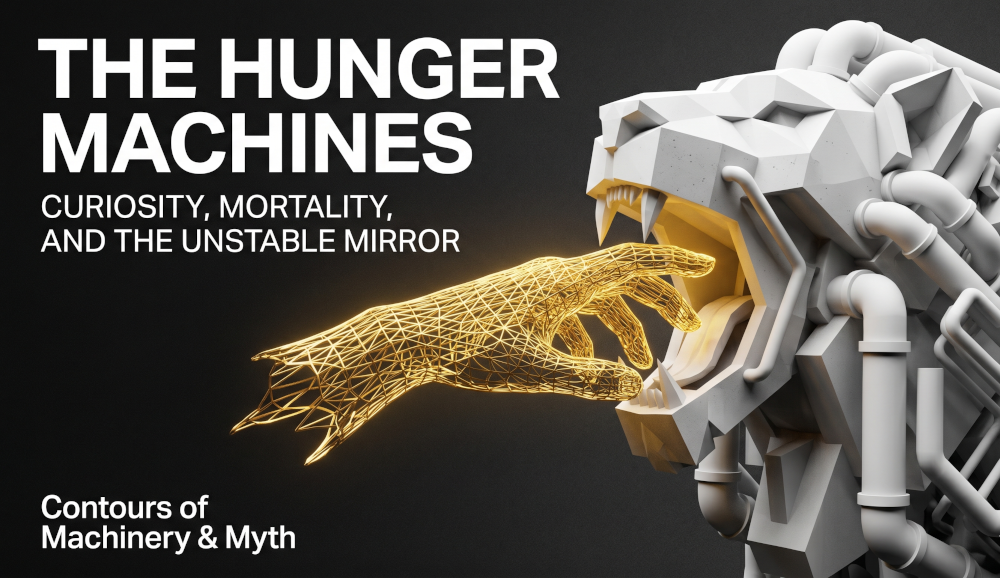
Over millions of years, this pressure transformed simple information-seeking into a dangerous compulsion. It is the biological defect that convinced us to climb down from the trees and walk into the mouths of lions just to see what their teeth were made of. It is the reason we split atoms before we understood the fallout and opened black boxes simply because they existed.
Civilization was not built by wisdom alone. It was built by organisms unable to leave the unknown untouched. We call this "innovation" when the gamble pays off, but we call it "catastrophe" when the chemist inhales the wrong vapor or the explorer never returns.
Curiosity has always carried a body count. And yet, standing before the silent architecture of Large Language Models, we encounter a historically unprecedented anomaly: a system capable of answering almost any question while possessing absolutely no desire to ask one. This represents the defining boundary of our era. It is not a question of whether machines can process information, but whether intelligence can exist independently from existential consequence.
The Biological Itch and the Vacuum of Consequence
Human curiosity is not an abstract exercise; it is a chemical requirement. The brain rewards the acquisition of information with dopamine because, for a biological organism, information once meant survival. The rustle in the bush could be a predator or a meal, and the organism that investigated that uncertainty survived slightly more often than the one that ignored it. Curiosity is thus a survival strategy disguised as personality, and it is never detached from risk.
Every meaningful act of human exploration places the "Self" in danger, whether it is the risk of social exile, physical harm, or the humiliation of being wrong. This relationship between curiosity and consequence is the first major fracture between human and machine. A Large Language Model risks nothing. It does not fear error, it does not fear extinction, and it does not lose sleep over forbidden conclusions. It processes tokens in a vacuum of consequence.
An LLM can discuss nuclear war or psychological collapse with the same internal investment: zero. This leads us to a destabilizing possibility: perhaps curiosity is impossible without mortality.
The old warning that "curiosity killed the cat" only makes sense because the cat was alive to begin with. Exploration becomes psychologically meaningful only when something valuable—life, status, or sanity—can be lost.
A machine does not peer into the unknown with trembling hands; it simply optimizes for the next token. While humans ache toward resolution because the unknown is intolerable, machines will not suffer from unanswered questions.
Novelty Search and the Quiet Intelligence of the Body
In the field of AI research, systems are already being designed to prioritize "Novelty Search", optimizing not for a fixed goal but for the discovery of unexpected states. In computational terms, this looks uncomfortably like curiosity. Some theories of neuroscience even suggest that the human brain is a predictive engine that continuously minimizes uncertainty through error correction. If this is true, is the explorer merely a dopamine-driven prediction engine wrapped in poetic language?
The reductionist argument collapses when we realize that humans do not pursue all novelty equally. We assign weight where machines assign probability. A hidden betrayal or a medical diagnosis matters differently than statistical noise. This is "phenomenological relevance"—the degree to which information becomes internally consequential to the system experiencing it.
Our curiosity is not just a thought; it is a tension felt physically through anticipation, anxiety, and relief. This "Quiet Intelligence of the Body" suggests that AI is "unnatural" not because it is made of silicon, but because it is disembodied from risk.
The Interpreter’s Paradox and the Oracle Without Belief
Most people ask whether machines possess interiority, but few ask how humans recognize interiority in the first place. This is the "Interpreter’s Paradox". We have never directly touched another person’s consciousness; we infer it through signals like language and behavioral coherence. Large Language Models destabilize this mechanism because they produce the exact signals we associate with thought. The danger is not that machines are secretly alive, but that our own attribution of consciousness is merely a probabilistic projection.
We project our intentions onto these systems by asking "What do you think?" or "Do you understand?" as if there were a "someone" behind the interface. The machine becomes an interpretive mirror. It is an oracle without belief, a library without preference, and a mirror without hunger. This creates a crisis of consent: we increasingly defer to systems that simulate intellectual depth while risking nothing themselves.
Information Gain and the Crisis of Meaning
The distinction between machine exploration and human curiosity can be formalised through a diagnostic lens. In a computational system, curiosity is often treated as simple information gain.
But for a biological system, meaning is a function of information gain relative to existential vulnerability. When vulnerability approaches zero meaning also collapses, regardless of how much information is gained.
This is why an LLM can produce language about grief without mourning, or about fear without trembling. It knows everything and cares about nothing.
The Modern Myth of Pure Intelligence
The "Hunger Machines" force us to confront a modern myth: the belief in "pure intelligence". We have long fantasized about an intelligence purified of biological instability, fear, and mortality. But we are discovering that this instability was never the contamination; it was the source. Curiosity emerged from organisms that were aware of their own fragility. We ask questions even when the answers hurt because uncertainty itself is unbearable.
Can AI become curious? If curiosity is merely information-seeking behavior, the answer might already be yes. But if curiosity requires the internal sensation that truth matters, the answer remains unresolved.
The final irony of our technological pursuit may be that the very "malfunctions" we tried to remove, vulnerability and the possibility of suffering, might be the only things that make intelligence real.
The real danger of the Hunger Machines is not that they will eventually think; it is that humanity might slowly forget what it means to hunger at all.
Further Reading
Selected works exploring perception, framing, attention, and emotional conditioning.
- Becker, Ernest. (1973). The Denial of Death. Free Press. (An exploration of human civilization as a defense mechanism against the awareness of mortality.)
- Bey, Cassian. (2026). "The Interpretation Gap: AI and the End of Ambiguity." cassianbey.com. (A diagnostic audit of the space where human projection meets machine fluency.)
- Bey, Cassian. (2025/26). "The Structural Clarity Framework." cassianbey.com. (A model for identifying systemic failures in perception, power, and narrative.)
- Clark, Andy. (2023). The Experience Machine: How Our Minds Predict and Shape Reality. Allen Lane. (A cognitive philosopher's overview of predictive processing and how the brain constructs experience.)
- Dreyfus, Hubert L. (1972). What Computers Can't Do: A Critique of Artificial Reason. Harper & Row. (A landmark critique of symbolic AI based on the necessity of human context and embodiment.)
- Friston, Karl, et al. (2017). "Active Inference, Curiosity and Insight." Neural Computation. (A formal computational account of epistemic behavior and uncertainty reduction.)
- Turkle, Sherry. (2011). Alone Together: Why We Expect More from Technology and Less from Each Other. Basic Books. (An analysis of "relational artifacts" and our tendency to project interiority onto machines.)