
The Pinhole and the Flood
The myth of the lone creator is a comfortable lie. We cling to it because we want to believe in the source: the sweat-stained genius who willed every syllable into existence from the void.
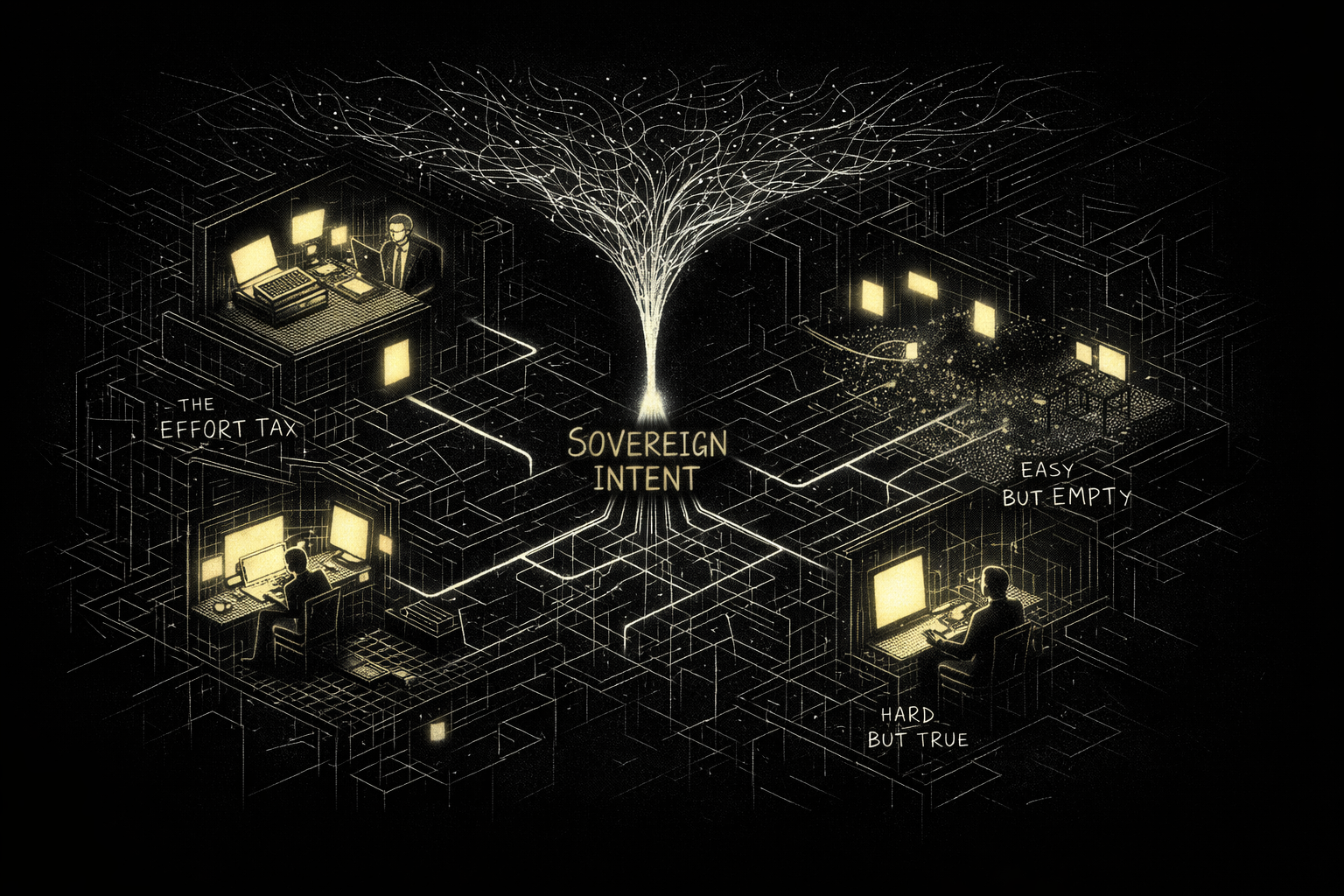
The history of the written word has always been a history of proxies, prosthetics, and hidden hands. From the scribes of kings to the speechwriters of presidents to the ghostwriters of billionaires, the name on the spine has rarely been the hand on the pen. As such, the myth of the lone creator is a comfortable lie. Time has come to reclaim the Sovereignty of Intent.
Today, we face a new tension: the silicon scribe. As the Large Language Model enters the workflow, a reflexive wall of dismissive noise has risen. People see a rhythmic cadence, a specific punctuation mark, or a "three-em-dash" pattern, and they fire off their low-fidelity judgment: "This is AI. You are an idiot." They believe they are defending the human soul, but in their rush to categorize, they become the very thing they claim to hate: a pattern-recognition algorithm running on a biological loop.
To understand the reality of authorship in 2026, we can look at two extremes of the spectrum: the branded billionaire and the trapped genius.
The Ghost and the Brand
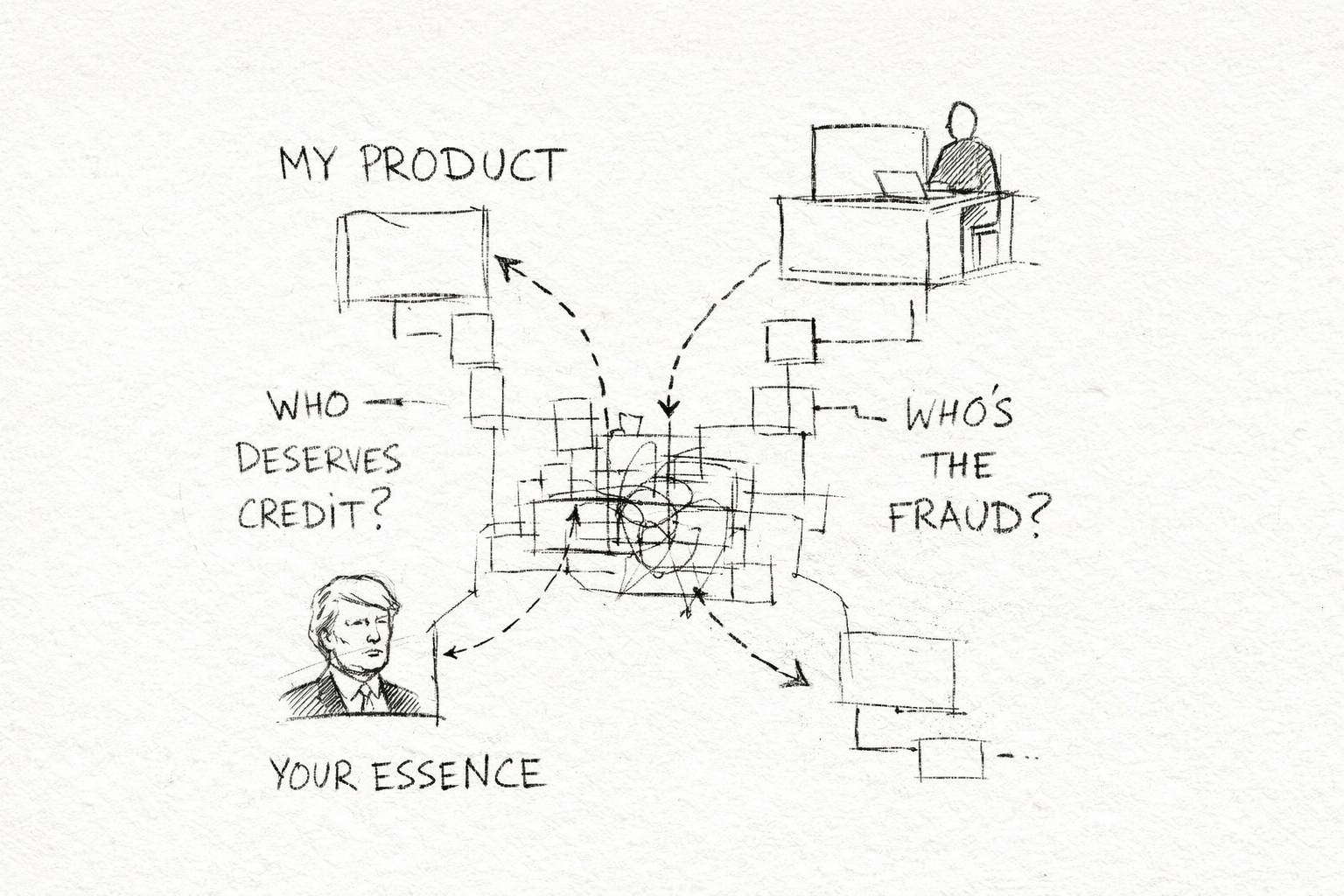
Consider The Art of the Deal. The public treats it as a primary text of the Trump persona, yet it is common knowledge that Tony Schwartz lived in the rooms, recorded the calls, built the voice and wrote the book. Trump provided the "vibe". Schwartz provided the words, the structure, the narrative arc, and the literary polish.
Society gives this a pass. Why? Because we have a historical "Effort Tax" that we apply only to the middle class. We accept that "Great Men" are too busy to type. Their authorship is an act of executive production. They are the "Director," and the ghostwriter is the "Crew." We don't call them fakes because we believe the intent is theirs, even if the labor is delegated.
This is the ultimate irony of the critic: they will quote a ghostwritten book as gospel while dismissing a self-edited AI draft as trash. They value the human-to-human delegation because it feels "organic," ignoring the fact that the ghostwriter often invents more of the "soul" than the subject ever possessed.
The Narrow Straw of Stephen Hawking
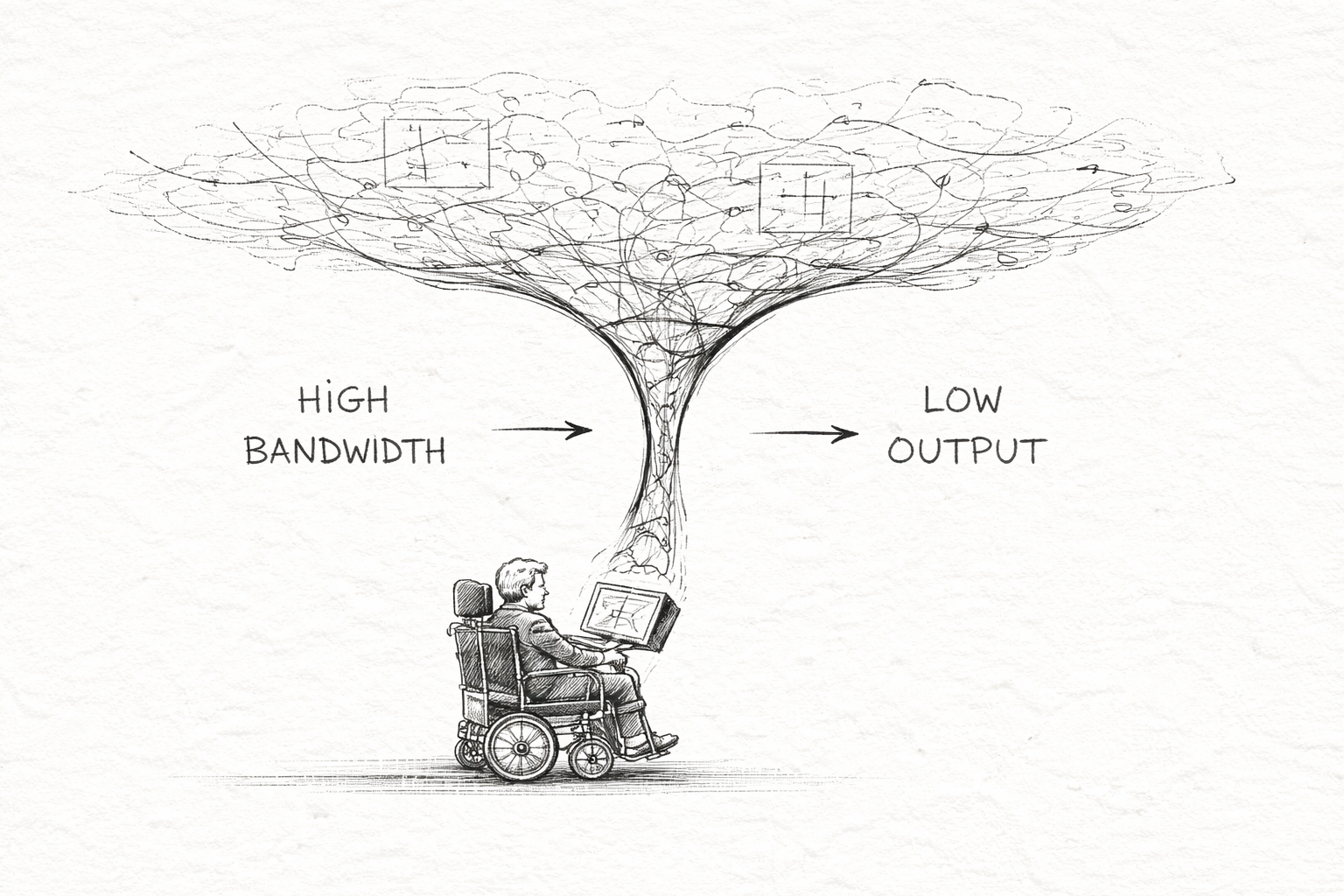
At the other end of the scale sits Stephen Hawking. Here was a man with a mind like an ocean and a "keyboard" like a pinhole. Hawking’s communication was a miracle of low-bandwidth persistence. He used predictive algorithms, the early ancestors of the LLMs we use today, to guess his intent. When he twitched his cheek, the machine suggested "Black Hole." He didn't type every letter; he selected the path.
Later, he used student assistants to flesh out his "core nuggets" into chapters. He provided the specific, dictated instructions, the skeletal logic, and they provided the connective tissue.
Hawking used technology to overcome a physical bottleneck to express original, internally generated thoughts. He knew exactly what he wanted to say; the machine just helped him say it faster. The difference is not the tool, it is the direction of intent.
Too many users outsource their thoughts to a machine designed for the median and the agreeable. In doing so, the structural thinking is outsourced. Hawking didn't ask his computer "What do I think about black holes?"
No one would dare call Hawking a fraud. We recognized that the "work" was the cognitive labor of selection and the ruthless pruning of intent.
Hawking’s authorship was not an act of production and the machine was not his collaborator; it was his interface. It was the prosthetic that allowed a trapped mind to touch the world without diluting the truth.
The Director in the Machine
The modern writer using an LLM is doing what Hawking did, but without the "visible struggle" that earns them a social pass.
When you "ram your argument, tone, style and intent through" a model, you are not pressing a button and walking away. You are standing in a firehose of probability and trying to aim it at a single, specific point of truth. Your truth. If you let the machine write 1,200 words on a "brainfart," the result is a beige wall of corporate fluff that is perfectly grammatical, optimized for agreement and entirely disposable.
Authorship is not the act of generating text; it is the act of choosing text. It is the "Director" looking at the first draft and saying, "No. This is too soft. This rhythm is wrong. This is not what I meant. This sentence does not work."
In cinema, a director manages the chaotic brilliance of human actors; the AI director manages the terminal boredom of the statistical median. If you direct a machine that only knows how to be average, your sculpture is made of damp sand, not marble. You are fighting a constant gravitational pull toward cliché that a probability map is literally programmed to avoid.
Although part of the labor has shifted from the production of the rough block to the refinement of the sculpture it gives the now popular assumption that "production" (the act of writing the first draft) is a mindless task that can be skipped.
You cannot "refine" a truth you never bothered to discover through the manual labor of thought.
If you are scrutinizing every argument, paragraph, sentence, word, letter, comma, every point, and every nuance. If you are wrestling with the machine to force it into a shape that matches the ache in your chest. When you are the one who is liable for its failures and the one who owns its insights. Then you are the author.
The Hypocrisy of Pattern Recognition
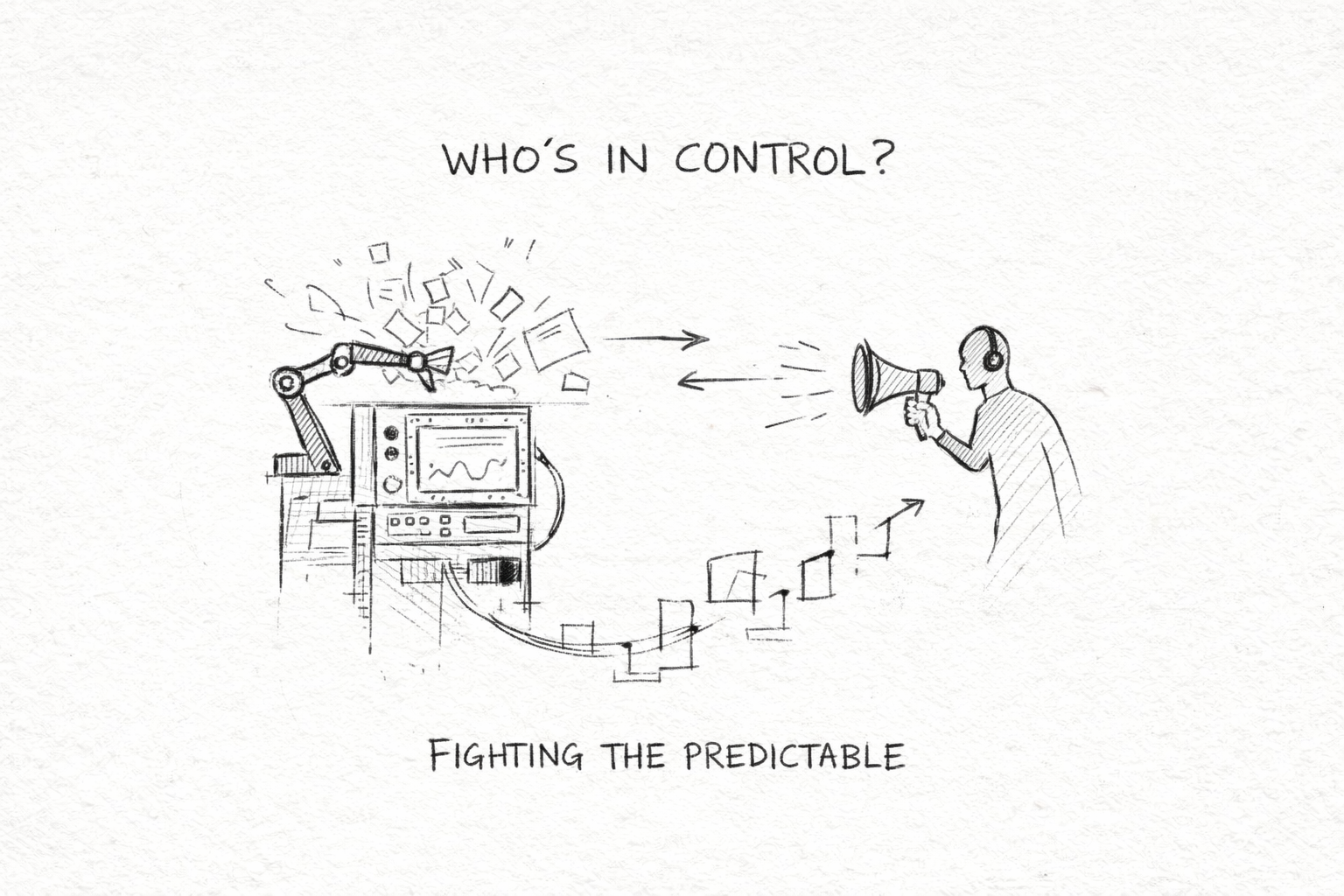
The "AI Spotters" of 2026 are running a bugged software. They see a specific structure like an "if this then that" logical flow or an abundance of em-dashes (‘—’) and they trigger their dismissive classifier.
But this is not a critique of ideas. It is a refusal to engage with meaning. By focusing on the "telltale signs" of the tool, they ignore the substance of the argument. They have become stochastic parrots themselves, repeating the "AI is bad" mantra because it is the most probable social response in their digital environment.
Also, they might ignore that a human writer might also choose an em-dash because it provides the exact rhythmic pause required for the thought to land. They ignore that the "final run-through" where you manually strip out the AI's "beige" artifacts is actually a ritual of reclamation by the author, by the director, the composer.
When you delete the "In summary" and the "Moreover," when you break the triple-list into a jagged pair, you are performing a counter-intelligence sweep against the machine. You are scrubbing the fingerprints of the tool to protect the sanctity of your intent.
The Sovereignty of Intent
We are currently in a "social lag." We have not yet reconciled the speed of the tool with the depth of the work. People are terrified that if writing becomes "easier," the "soul" will vanish.
But the soul doesn't live in the pen; it lives in the person who decides where the pen goes.
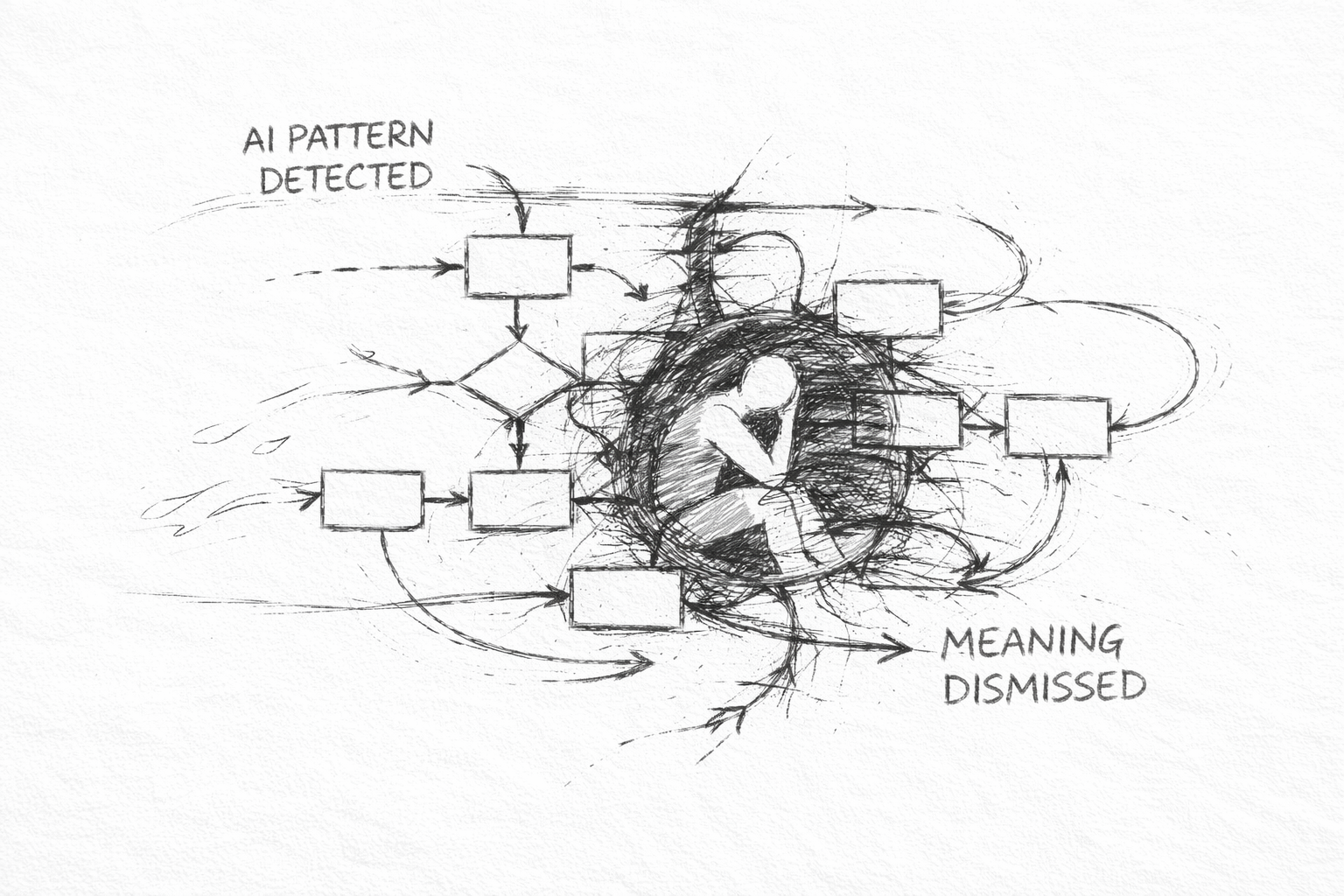
Humanity is currently overloaded and subtly gaslit into believing that their own cognitive labor is "cheating" if it uses a new interface. We are taught to mistrust our intuition if it is assisted by silicon. But the "ache" that drives the writing, the quiet longing to be seen without the mask is not something an LLM can simulate.
The machine has no ache. It has only probability maps.
The work remains simple and hard: To reclaim sovereignty over attention. To use the tool as a prosthetic for the mind rather than a replacement for the heart. To "ram through" the truth until the machine’s generic output is crushed under the weight of a specific, human voice. Your voice.
In the end, the "damn difference" between the billionaire’s ghost writer, the genius’s computer as a prosthetic, and the modern writer’s LLM is nothing more than a social construct designed to gatekeep the act of creation.
If the words on the page are the result of your thoughts, your arguments, your tensions, your curiosity. If they are the results of you selection, your editing, and your relentless pursuit of coherence, then the work is yours.
The critics can keep their pattern recognition, performing the same routine as the machine they fear: their parrot arguments making them just as algorithmic and predictable as the LLMs they dismiss.
We will keep the truth. Awareness keeps leaking through not because the system permits it but because the human director, even when aided by a machine, remembers who is in charge of the story.
And ensures it.
REFERENCES: THE PINHOLE AND THE FLOOD
I. THE GHOSTWRITING OF THE BRAND
- Jane Mayer,(http://www.renevanmaarsseveen.nl/wp-content/uploads/overig5/Trumps%20Boswell%20Speaks%20-%20The%20New_Yorker%20-%2025%20July%202016.pdf) The New Yorker (July 2016). The foundational account of Tony Schwartz’s role in constructing the "Trump" persona and the concept of "truthful hyperbole."
- PBS Frontline,(https://www.pbs.org/wgbh/frontline/interview/tony-schwartz/) The Choice 2020. A detailed oral history regarding the 18-month shadowing process and the structural delegation of authorship.
- Howard Bernoff,(https://bernoff.com/blog/donald-trump-art-deal-ethics-ghostwriting) Without Bullshit. An analysis of the "Truthful Hyperbole" paradox and the moral weight of editorial synthesis.
II. THE PROSTHETIC VOICE OF HAWKING
- Intel Labs,(https://github.com/intel/acat) GitHub. The open-source architecture of the "Interface" designed for Stephen Hawking to bridge the gap between biological latency and digital output.
- VentureBeat,(https://venturebeat.com/technology/how-stephen-hawking-is-using-swiftkey-to-communicate-twice-as-fast) (December 2014). A technical examination of the predictive algorithms and personal "probability maps" that allowed for a high-fidelity intent-to-word transition.
- Computer History Museum,(https://computerhistory.org/blog/how-dectalk-gave-voice-to-a-genius-engineering-stephen-hawkings-wheelchair/) @CHM. A historical diagnostic of the specific hardware and the robotic "Perfect Paul" voice that Hawking adopted as a permanent identity.
- The MIT Press Reader,(https://thereader.mitpress.mit.edu/stephen-hawkings-eternal-voice/) (March 2018). An ontological analysis of how a software-emulated voice becomes a "trademark" and an extension of the physical body.
- NextGov,(https://www.nextgov.com/artificial-intelligence/2018/03/ai-gave-stephen-hawking-ability-communicate-despite-his-fears-tech/146684/) (March 2018). Insight into the training of ML algorithms on a specific corpus of work to predict high-bandwidth intent.