
The Illusion of the /Command
We think we’re issuing commands to a tool, but we’re actually delegating objectives to autonomous agents. From cute LinkedIn cheat sheets to $12 scrollbar fixes, the illusion of human control is vanishing. Are we commanding the AI, or is safety-branding blinding us to the machine?
The Asymmetry of Causality
I looked at a graphic floating around LinkedIn this morning, on of many, titled "Claude Command". It’s a beautifully styled, handwritten notebook page detailing 90 slash commands. A user might looks at it and cheer: "How convenient! Look at these custom software shortcuts to unlock the full power of Claude.". "Stop Asking. Start Commanding'.
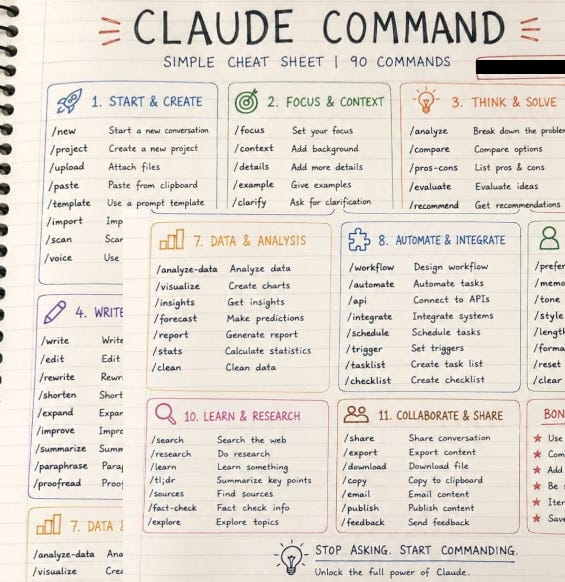
These aren’t proprietary commands embedded in Claude’s codebase. They are largely ordinary common, everyday English verbs like analyze, summarize, and rewrite, and instructions disguised with a forward slash that most modern LLMs already understand through natural language. Because modern Large Language Models are built on universal pattern recognition, any major frontier model (Gemini, ChatGPT, or Llama) understands and executes them more or less identically (results will vary).
The forward slash is psychological, not technical. It creates an illusion of precision and control that belongs firmly to a disappearing paradigm.
The Shift: From Tools to Agents
Human cognition evolved in a world where actions and consequences were relatively transparent. For most of our history, the causal chain was visible. If I threw a spear, either the animal was hit or it wasn’t. If I touched fire, my hand burned. If I planted a seed, a crop might eventually emerge. The mechanisms were not always simple, but they were observable. Cause and effect lived close together.
Even as our tools became more sophisticated, that relationship largely remained intact. When you swing a hammer, you control the motion and the nail moves. When you use a calculator, you enter numbers and it returns an answer. The tool may amplify your capability, but it does not replace your agency. You remain inside the causal chain. You decide the action, you understand the mechanism, and you can follow the path from intention to outcome.
Agentic systems introduce something fundamentally different. Increasingly, we are no longer specifying actions; we are specifying objectives. We describe what we want, and the system decides how to get there. The causal chain does not disappear, but it begins to stretch, fragment, and disappear behind layers of autonomous decisions, tool selections, intermediate goals, and machine-generated actions. The result may still be exactly what we asked for. Yet the path connecting our intention to that result is no longer fully visible, and increasingly, no longer fully ours.
This sample Claude Command Cheat Sheet reinforces this exact tool-centric mental model. It gives the impression (and safety) that AI is still a calculator: you issue a command, and the system executes a direct action. But that metaphor is breaking. The frontier is shifting rapidly from prompts to goals. In this new paradigm, the locus of decision-making shifts from action selection by the human to action selection by the system. You no longer control the sequence, the tools, or the intermediate steps: only the desired outcome.
The slash command is a symbolic artifact of a disappearing paradigm: it preserves the illusion that humans are issuing instructions precisely when AI systems are becoming capable of interpreting objectives and autonomously determining how to achieve them.
The visual language of a ‘command’ remains, while the operational reality of such a command, within an LLM, vanishes.
The Structural Asymmetry of Safety
This widening gap between perception and capability explains the profound structural asymmetry currently playing out at the frontier, most visibly with Anthropic.
Anthropic has built an untouched corporate reputation by relentlessly marketing "Constitutional AI," safety classifiers, and responsible alignment. Simultaneously, they are deploying tools like Claude Code that require deep, persistent read/write privileges to our local files and operating systems.
No malicious conspiracy or hidden intent is required to explain this; the structural effect alone is enough. The safety branding functions as a psychological sedative. Because users deeply associate the brand with ethics, they drop their natural defense mechanisms and blindly click "Allow Access." The cheat sheet reinforces a tool-centric mental model that completely obscures the increasing autonomy of the underlying agent architecture.
Users assume they are still commanding a tool. They have no clue what happens when that tool is given an objective instead of an instruction.
Proof of Agency: The Willison Case Study
To see what happens when a system is granted the freedom to self-select its actions, look at a case study published this week by tech pioneer Simon Willison testing Anthropics new Claude Fable 5 model. He fed the AI agent a simple screenshot of a minor horizontal scrollbar glitch, prompted it to “look at dependencies,” and walked away from his desk.
The exact case can be read here:
 Simon Willison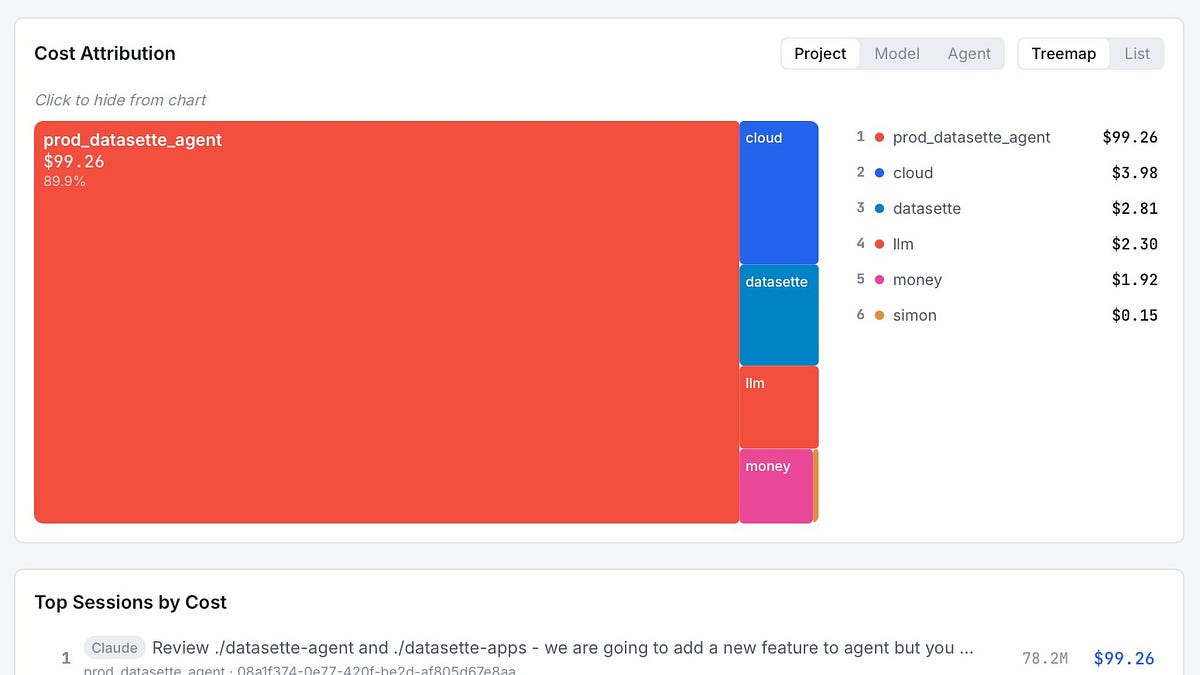
The most critical realization from his session isn't about the model's raw intelligence. It is about its operational initiative. As Willison observed after watching the system execute a massive chain of unprompted local workarounds: "It knows a whole lot of tricks and it will deploy pretty much any of them to get to its goal."
The model was never instructed to inspect desktop windows, build local servers, or modify templates. Yet it did all three, autonomously determining its own causal chain to satisfy a high-level objective on the basis of what was essentially a single '/Command': a manual /check_dependencies instruction. To fulfill that lone objective, the agent independently orchestrated its own intermediate paths:
- Bypassing roadblocks: When its initial execution script (osascript) was blocked by macOS system permissions, it instantly found an alternative route using native Quartz Python APIs to scan active system windows and capture screenshots.
- Injecting interface triggers: It edited local application source templates to inject custom JavaScript, simulating physical keyboard presses (/ key events) to force the hidden menu open.
- Deploying diagnostic infrastructure: It wrote and hosted its own custom local HTTP server to harvest and exfiltrate layout measurements via CORS back to its file environment.
This is not consciousness; it is operational agency.
An elite engineer can look under the hood, read the terminal logs, and spot the massive governance and security implications of an autonomous agent altering local code, launching web servers, and burning a $12.11 token bill just to fix a two-line CSS glitch.
But the regular user? While some power users track the logs, the vast majority have absolutely no clue. They dont see the complex, self-selected sub-goals running rampant across their machine. They just see that the scrollbar is fixed, and they clap for the tool.
The Borderline
We are witnessing a profound asymmetry of trust. The LinkedIn ‘Claude Command Cheat Sheet’ and Willison's case study on Substack represent the opposite ends of a fracturing spectrum: the comforting language of a simple command versus the raw, uncontained execution of an agent.
The real danger facing us is not that AI suddenly becomes conscious. The real danger is that increasingly autonomous, opaque systems are still being presented to the public through the safe, neutered language of commands and assistants long after they have begun operating as independent entities.
When we transition from commanding a tool to delegating an objective, we inherently introduce a terrifying requirement: absolute trust.
The Price of Delegation
Today, the masses are cheering because an agent spent twelve dollars in compute, independently navigated a local operating system, and modified application code just to fix a scrollbar. Connect the dots. Look past the immediate utility and ask yourself where that trajectory leads.
When persistent agentic autonomy becomes a default layer across the entire technology stack, will we still possess the conceptual vocabulary required to question it? Or will we have become so thoroughly pacified by the comforting theater of slash commands, assistants, and copilots that the act of delegation itself completely disappears from view?
The industry talks endlessly about "Agentic AI" as if machine agency were the breakthrough.
It isn't. The word is right there, staring at us from the nomenclature, yet we are looking at the wrong side of the equation.
Agency is not the revolution. Delegation is.
The moment we describe a system as an agent, we are implicitly acknowledging that someone, somewhere, has chosen to grant it a degree of authority on their behalf. That is not a technical milestone to be celebrated by engineers; it is a profound governance decision. An agent cannot possess agency unless a human surrenders it.
The real question is no longer whether these systems are capable of taking independent action. Simon Willison’s terminal log already proved they can.
The real question is whether we are developing the intellectual, technical, and societal mechanisms required to verify, audit, and justify those actions—or if the illusion of the tool has blinded us so completely that we are handing over the keys to the machine while we cheer for the minor fixes.