Why the Universe Isn’t Shifting — You Are
Scroll or watch long enough and you’re told the universe will rearrange itself if you just let go. Frequencies align. Timelines shift. Reality responds. It feels scientific. It feels comforting. But the experience points to something closer, and more human, than the explanation suggests.
There is a moment many people recognize. A moment when effort softens, when pressure is released, when the grip loosens just enough for something to move again. A conversation shifts. An obstacle that felt solid loses its edge. An option appears where none seemed available. From the inside, it can feel as though reality itself has changed.
The internet is quick to offer explanations. You aligned your frequency. You exited resistance. You slipped into a different timeline and the universe responded. It is a comforting story, and it speaks to something real. But it is often not the right explanation. Not because nothing changed—something clearly did—but because what changed is closer, simpler, and more human than cosmology suggests.
People are not imagining the experience. When pressure drops, movement often follows. When fixation eases, possibilities return. When urgency dissolves, timing improves. From within, this can feel like grace, like guidance, even like a small kind of magic. That feeling deserves respect. The confusion begins only when the experience is elevated into a theory of reality.
Much of modern spiritual language borrows the authority of science. Words like frequency, energy, observer, and parallel timelines sound precise, even rigorous. But in these explanations, they function as metaphors rather than mechanisms. Emotional shifts are described using physical language, and psychological relief is promoted into a claim about how the universe operates. The experience is real. The explanation is not.
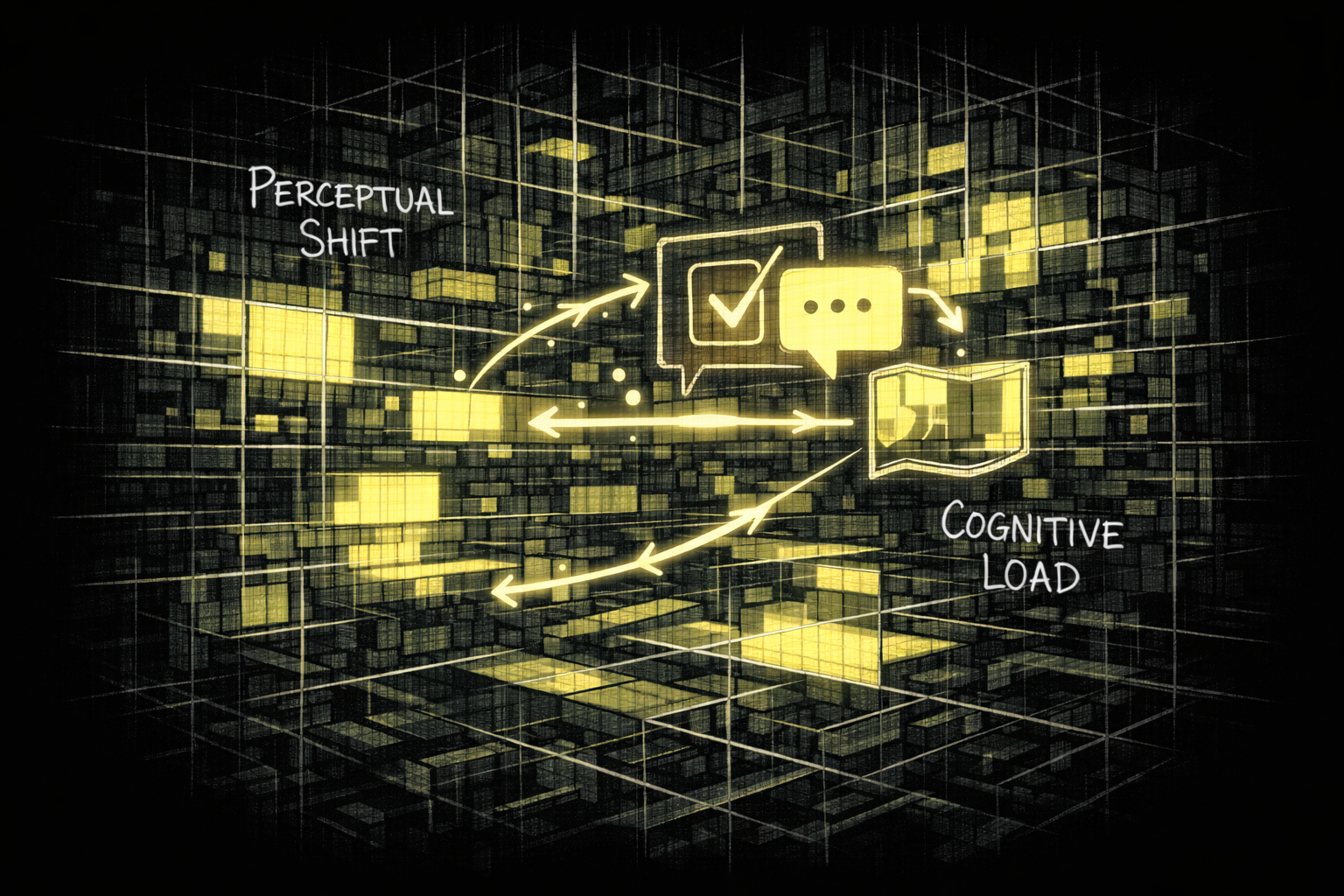
What actually changes when people “let go” is not the world, but their relationship to it. Under emotional pressure, perception narrows. Threat sensitivity increases. Identity fuses with outcome. Choice becomes urgent and heavy. Nothing mystical is happening, but navigation becomes distorted. Fewer options are visible. Familiar paths are repeated. Effort escalates where leverage is absent. The world begins to feel resistant, even hostile, when in fact the map has collapsed.
Letting go does not move anyone into a new timeline. It removes the load. As pressure drops, perception widens. Identity loosens. Interpretation stabilizes. Options that were always present become visible again—not because reality changed, but because distortion stopped obscuring them. Movement returns, not through force, but through timing.
This is why it feels as if things suddenly begin to flow. Flow is not a property of the universe. It is the absence of interference in the navigator. Humans experience contrast more readily than causality. Before there was stuckness; after, there is motion. The internal transition is subtle and mostly invisible, so the mind concludes that the world must have shifted.
In truth, nothing external needed to bend. What changed was position within the same reality, not through vibration or attraction, but through clarity. The sense of being helped, guided, or carried is not something to dismiss. It is what regained coherence feels like from the inside.
Reality did not rearrange itself for you. And that is not a loss. What happened is quieter, and more empowering than that. You stopped acting from distortion. You recovered perceptual accuracy. You regained flexibility and leverage. Nothing mystical was required.
The universe did not move.
You did.
And sometimes, that movement is gentle enough to feel like magic.
Further Reading
Selected works exploring perception, framing, attention, and emotional conditioning.
Damasio, Antonio. Descartes’ Error (1994).
Explores how emotion shapes perception and decision-making.
Gilbert, Daniel. Stumbling on Happiness (2006).
Examines how cognitive projection distorts our sense of possibility and outcome.
James, William. The Principles of Psychology (1890).
Classic account of attention, perception, and the stream of consciousness.
Kahneman, Daniel. Thinking, Fast and Slow (2011).
Details how cognitive load and bias narrow perception under pressure.
Lazarus, Richard S. Emotion and Adaptation (1991).
Analyzes how appraisal processes shape stress and behavioral flexibility.
Porges, Stephen. The Polyvagal Theory (2011).
Links nervous-system regulation to perception of threat and openness.
Rogers, Carl. On Becoming a Person (1961).
Discusses how reduced defensiveness restores psychological flexibility.
Siegel, Daniel J. The Developing Mind (1999).
Explores integration as the basis of coherence and adaptive flow.