When Code Becomes Cheap, Responsibility Becomes Expensive
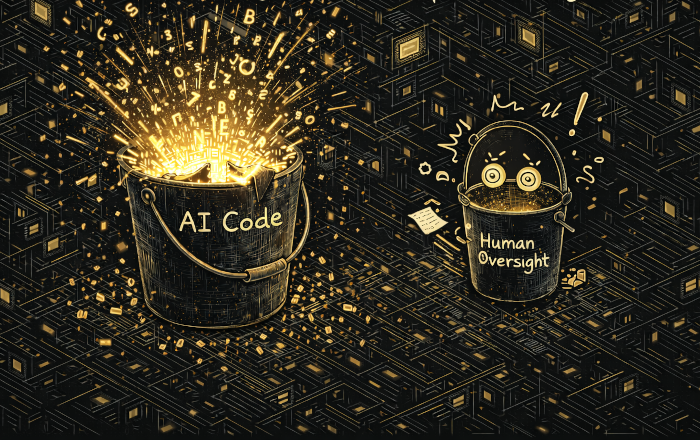
AI will not kill coding. As AI and LLMs make software generation cheaper, the demand for complex software systems will explode. The real shift is from writing code to auditing architecture, debugging AI-generated systems, and managing the hidden error rates inside increasingly complex software.
Why AI Will Create More Engineers, Not Less
The First Rule of AI Software Economics: When the cost of producing code approaches zero, the complexity of software approaches infinity.
There is a specific kind of silence that happens right before a hype cycle breaks. It’s the sound of everyone agreeing on a future that hasn’t been built yet. Today, that silence is filled with the prediction that before we know it, the act of "coding" will be a relic, a Victorian-era craft like chimney sweeping or hand-weaving. The "God Prompt Gurus” tell us that we are a few years away from a world where software is spoken into existence by "visionaries" who never have to touch a semicolon.
It is a beautiful story. It is also a fundamental misunderstanding of what a developer actually does.
If we are to find the truth, we have to look past the "Black Magic" ads and look at the math and the history. We have to deconstruct the hype to find the signal.
I. The Coal and the Code
To understand the future of code, we have to go back to 1865. The English economist William Stanley Jevons noticed something troubling. As the steam engine became more efficient, requiring less coal to produce the same amount of work, the logic suggested that total coal consumption should drop. Instead, it skyrocketed. Because coal was now "cheap" and "efficient," it became viable for a thousand new industries. This is the Jevons Paradox, and it is currently eating the software world alive.
When a guru tells you that AI will replace coders, they are assuming that the world’s demand for software is a fixed pie. They think that if an AI can do the work of 10 coders, then nine of those coders must lose their jobs.
But software is not a fixed pie. It is an infinite gas that expands to fill every available crack in human civilization.
As AI drops the "cost per line" to near zero, we won't build the same apps with fewer people; we will build systems 100x more complex, 100x more integrated, and 100x more ambitious. The "replacement" is a mirage. The reality is an explosion of responsibility.
II. The Geometry of the Error
The second flaw in the "In a Few Years Myth" is technical. Large Language Models are, by nature, local-pattern recognizers. They are excellent at seeing the "tree". The 50-line function, the CSS centering, the regex pattern. But software is not a collection of trees; it is a forest of interdependencies.
In software architecture, we deal with something called State Space Complexity. Every time you add a module, a library, or an AI-generated feature, the number of potential states the system can exist in grows exponentially. The problem is that AI-generated code carries a hidden error rate ($\epsilon$).
On a small scale this error rate appears negligible. But complex systems do not behave linearly. Their reliability compounds across components.
If the probability of an AI generating a perfect piece of code is $(1 - \epsilon)$, then the probability of a large, interconnected system of $n$ modules working perfectly is:
$$P(\text{Success}) = (1 - \epsilon)^n$$
As $n$ (the complexity of our systems) grows due to the Jevons Paradox, even a tiny $\epsilon$ (error rate) causes the probability of a systemic, silent failure to approach 100%.
The LLM does not possess a mental model of the architecture it participates in. It cannot understand that a change in an authentication header in 2026 may trigger a memory leak in a billing system in 2032. The system sees only the local pattern, not the global consequence. As software complexity expands, the number of invisible failure paths expands with it. AI can generate the code, but it cannot reason about the architecture that code becomes part of.
III. The Seniority Earthquake
This brings us to the human cost of the hype. Currently, we are seeing a “Seniority Gap.” Companies are increasingly hesitant to hire junior developers because AI can supposedly “do their job.”
This is a dangerous short-term hack. Coding is a craft of apprenticeship. The intuition required to understand complex systems is not acquired by prompting a machine, but through years of struggling with real failures. You cannot become a Forensic Logic Auditor—the person capable of spotting a one-percent error buried in a sea of AI-generated syntax—without first having been the person who wrote fragile code, broke it, and fixed it at three in the morning.
Some imagine that AI allows developers to skip the stairs and take the elevator directly to the top floor of architecture. But when the elevator eventually stalls, the system will depend on the people who still understand the machinery.
Remove the apprenticeship layer, and you remove the future generation capable of auditing the systems that AI will build.
IV. The Shift: From Typist to Auditor
So, what is the "High Signal" truth?
The "Coder" of 2032 will not be defined by their ability to memorize Python libraries. That part of the job is dying, and we should let it go. It was always the most boring part of the craft anyway.
The new developer's value lies in their ability to:
- Orchestrate: Chaining small, atomic AI outputs into a coherent, resilient architecture.
- Verify: Using statistical and formal methods to ensure AI isn't leading the company into a $P(\text{Success}) = 0$ trap.
- Translate: Moving between "Messy Human Requirements" and "Rigid Machine Logic", a bridge that no LLM has ever successfully crossed without a human guide.
V. Transparency over Hype
We have to stop being afraid of the “In a Few Years Replacement” headline. It is a ghost story designed to sell ghost-busting courses.
The real future is messier. Code will be everywhere, and true understanding will be scarce. The people who thrive will not be the ones with the “God Prompts,” but the ones who refuse to treat AI as a magic wand. Artificial intelligence is best understood as a fabrication machine for software. And like every fabrication machine in history, the faster it runs, the more valuable inspection becomes.
Transparency is the only thing that scales. Don’t buy the magic. Understand the math. The semantical typing is fading, but the requirement for human logic has never been higher. The semicolons may vanish, but the responsibility remains.
The mistake is to think that AI reduces the need for engineering. In reality, it removes only the cheapest layer of the craft. When production becomes effortless, oversight becomes the scarce skill. When code becomes abundant, understanding becomes rare. The developer of the next decade will not be valued for typing syntax faster than a machine, but for seeing the invisible architecture that machines cannot perceive.
Code may become cheap. Correctness never will.