The Wand and the Orchestra: on how stories prepare the future.
Stories do not command the future. They prepare it. Through repetition, framing, and familiarity, culture teaches what feels normal, what feels legitimate, and which futures feel inevitable—long before they arrive.
The Wand
Long before empires learned to rule by law, power moved through symbols. Not decrees, but gestures. Not force, but rhythm.
In pre-Roman Europe, authority was not always embodied by kings or armies, but by figures who stood slightly aside from power itself: those who named the seasons, guarded memory, and interpreted signs. Whether we call them druids or something else is secondary. What matters is their function: custodians of narrative continuity.
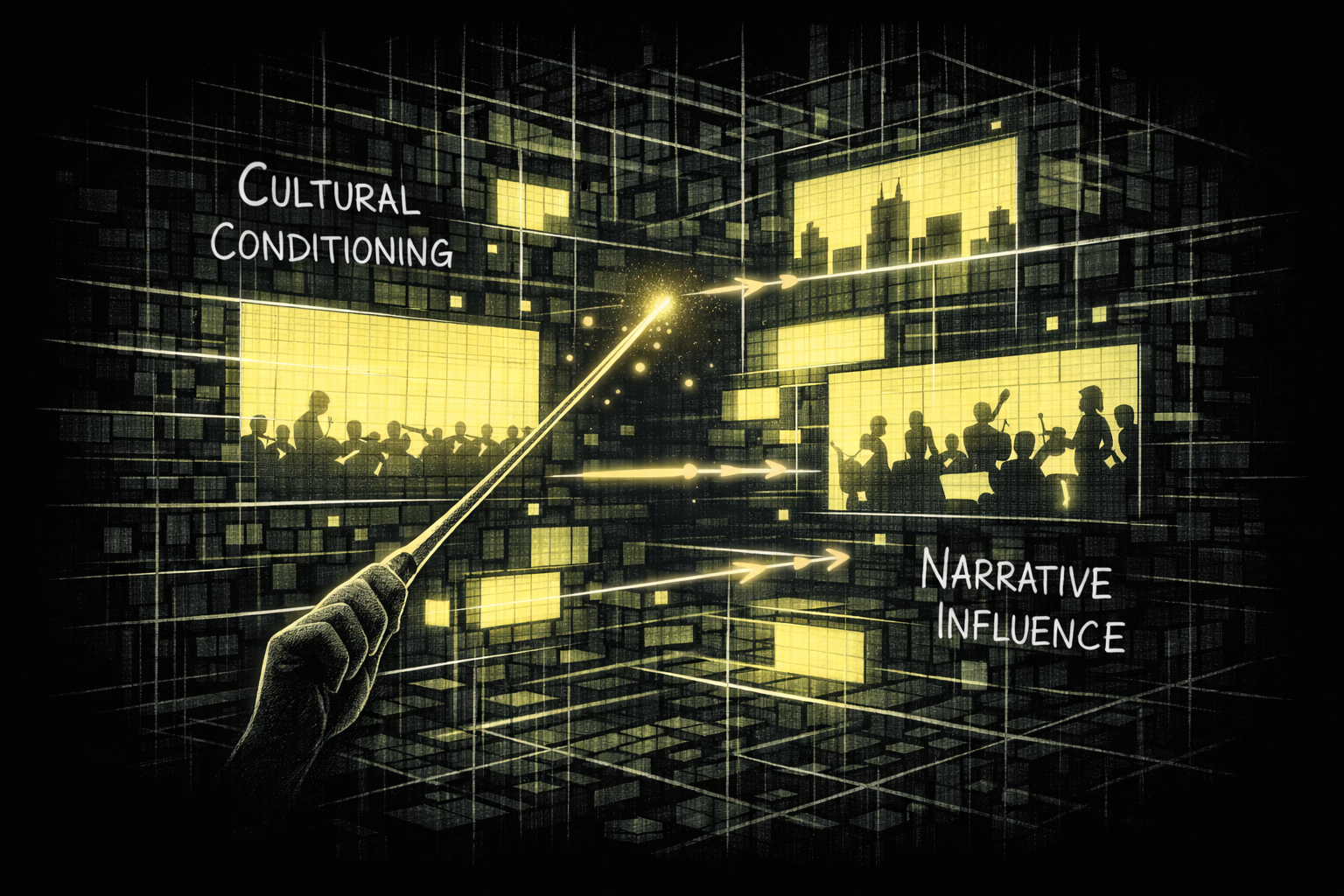
The wand is a useful image here—not as an object of superstition, but as a shorthand for coordination. A small instrument through which many act as one. The conductor does not produce sound; he aligns it. The orchestra follows not because of coercion, but because the gesture makes coherence possible.
Modern societies did not abandon this mechanism. They refined it.
What we call popular culture (film, series, spectacle) is not merely entertainment. It is a temporal instrument. It rehearses the past, stabilizes the present, and familiarizes the audience with futures that have not yet arrived. Not as instructions, but as emotional preconditioning. This is not conspiracy. It is infrastructure.
Stories teach us what kinds of actions feel normal, what kinds of authority feel legitimate, and which futures feel inevitable. They do not command; they tune. Over time, the audience learns the melody so well that it no longer notices the baton. The power of such systems lies precisely in their invisibility. When the story works, it does not feel imposed. It feels like common sense. Like culture. Like “the way things are.” In that sense, the wand never disappeared. It changed material. It learned to glow.
And the orchestra still plays.
The Orchestra
Inevitability is not fate—it is familiarity: stories do not define what is normal.They prepare the ground on which the future will feel normal.
Those who conduct culture—whether imagined as druids, magicians behind curtains, or technicians behind interfaces—do not rule by decree. They operate earlier, and more subtly. Their task is not to dictate behavior, but to condition recognizability: to make certain actions feel familiar before they ever arrive in reality. What appears on the screen is rarely a command. It is a rehearsal.
In this way, stories teach us what kinds of actions feel normal—not by instruction, but by repetition and framing. The unfamiliar is introduced gently, wrapped in narrative, emotion, and identification. By the time it emerges in lived reality, it no longer feels foreign. It feels overdue.
Stories also shape what kinds of authority feel legitimate. New forms of power are rarely announced as such. They are introduced first as characters, roles, solutions, or necessities. The screen confers legitimacy in advance, so that when authority changes shape, recognition precedes resistance. What was once unthinkable becomes reasonable. What was once questionable becomes practical. And finally, stories prepare futures that feel inevitable, and inevitability is not fate—it is familiarity.
A future feels inevitable when it has already been emotionally processed: anticipated, normalized, accepted, complied with. By the time it arrives, it does not arrive as a shock, but as confirmation.
This is why cultural power does not command. It tunes.
Over time, the audience learns the melody so well that it no longer notices the baton.
Further Reading
Selected works exploring perception, framing, attention, and emotional conditioning.
Anderson, Benedict. Imagined Communities (1983).
Explains how shared narratives construct collective identity and legitimacy.
Barthes, Roland. Mythologies (1957).
Analyzes how everyday cultural forms naturalize ideology.
Berger, Peter L., & Luckmann, Thomas. The Social Construction of Reality (1966).
On how repeated narratives stabilize what feels “normal.”
Debord, Guy. The Society of the Spectacle (1967).
Examines mediated reality and the power of representation.
Ellul, Jacques. Propaganda: The Formation of Men’s Attitudes (1962).
Details how repetition and framing condition perception before action.
McLuhan, Marshall. Understanding Media (1964).
Argues that media forms themselves shape perception and cultural rhythm.
Ricoeur, Paul. Time and Narrative (1983–1985).
Explores how narrative structure configures temporal experience.
Tversky, Amos, & Kahneman, Daniel. “The Framing of Decisions” (1981).
Demonstrates how presentation shapes interpretation and choice.