The Temple Cleansing Was Not About Coins. It Was About the System.
The temple cleansing was not a moral tantrum but a systemic strike: a direct assault on sanctified exploitation, where power, profit, and ritual merged. An ancient warning that still exposes how modern systems launder harm through holiness, necessity, and moral language.
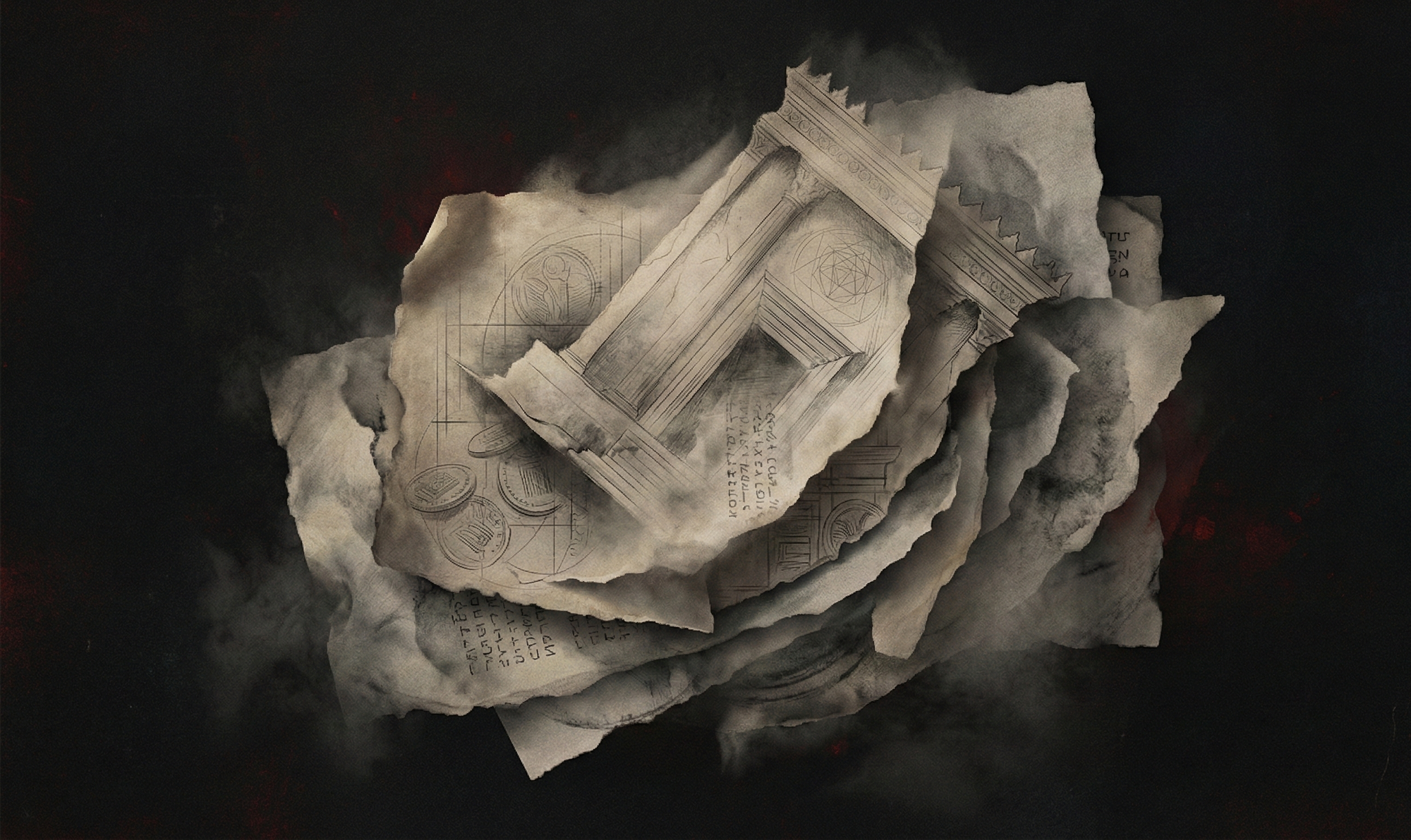
A few days before his arrest, a man from Galilee walked into the most powerful institution of his world—the Temple of Jerusalem—and overturned its tables. That moment, half a millennium of theology later, has been reduced to theatre: a carpenter having an outburst over currency exchange. It wasn’t. It was a precision strike on a system that had fused profit, ritual, and power into one sanctified machine.
When he shouted that they had made God’s house “a cave of bandits,” the words cut far deeper than the English cliché den of thieves. The Hebrew–Aramaic original—meʿarat paritzim—means a hideout for violent exploiters, the place where robbers retreat after a raid. In that single phrase the man condemned the entire pattern of sacred cover for systemic greed. The Temple economy was not an accident; it was policy. Animals were bought and slaughtered in vast numbers, money changed hands under priestly supervision, and a divine narrative framed it all as holy duty.
Two thousand years later, the pattern has simply scaled. The modern equivalents of those tables are not limited to religion. They’re built into the industrial-financial lattice that still trades life for profit and then hides behind moral language. We sanctify extraction with new liturgies: growth, security, shareholder value, national interest. The same old prayer—God wills it—has been re-coded in corporate and political tongues. And when the harm surfaces—forests burned, species erased, wars launched, children crushed by debt—we retreat to our new temples of justification and call the destruction inevitable.
The man in the Temple tried to stop precisely that reflex: the merging of exploitation with holiness, the laundering of violence through ritual respectability. It was not a tantrum; it was a prophetic act, a warning that the sacred collapses when it becomes a marketplace. For that, he was neutralized—swiftly, publicly, and with full institutional cooperation.
His gesture still stands as the one uncorrupted template for resistance: overturn the tables, name the racket, and walk straight into the consequence. The language of religion can still be reclaimed, but only if it breaks its addiction to wealth and control. If the sacred cannot defend the living world—the forests, the animals, the people it claims to steward—it is no longer sacred. It’s just another front office of the same cartel.
The real cleansing has barely begun. It won’t happen in marble cathedrals or climate summits. It begins wherever someone sees a lie disguised as holiness and refuses to trade silence for comfort. That is what the man from Galilee did. That is what every age must learn to do again.
Further Reading
Selected works exploring perception, framing, attention, and emotional conditioning.
Agamben, Giorgio. The Kingdom and the Glory (2007).
On the theological roots of governance and the fusion of economy and sacred order.
Borg, Marcus J. Conflict, Holiness, and Politics in the Teachings of Jesus (1984).
Situates the Temple action within first-century political and economic structures.
Crossan, John Dominic. Jesus: A Revolutionary Biography (1994).
Interprets the Temple episode as symbolic disruption of institutional power.
Girard, René. Violence and the Sacred (1972).Explores how ritual can mask and stabilize systemic violence.
Horsley, Richard A. Jesus and the Spiral of Violence (1987).
Examines resistance, imperial economy, and prophetic confrontation in Roman Judea.
North, Douglass C.; Wallis, John J.; Weingast, Barry R. Violence and Social Orders (2009).
Analyzes how institutions legitimize and contain violence through structured narratives.
Polanyi, Karl. The Great Transformation (1944).
On the embedding of markets within moral frameworks and the social cost of commodification.
Scott, James C. Domination and the Arts of Resistance (1990).
Explores symbolic acts that expose hidden transcripts of power.