Exposing the Architecture of the Rusty Cage
Modern power governs less by force than by fragmenting body, meaning, and relation shaping attention and trauma into compliance. Old logics of capture scale through modern interfaces, yet coherence continues to surface.
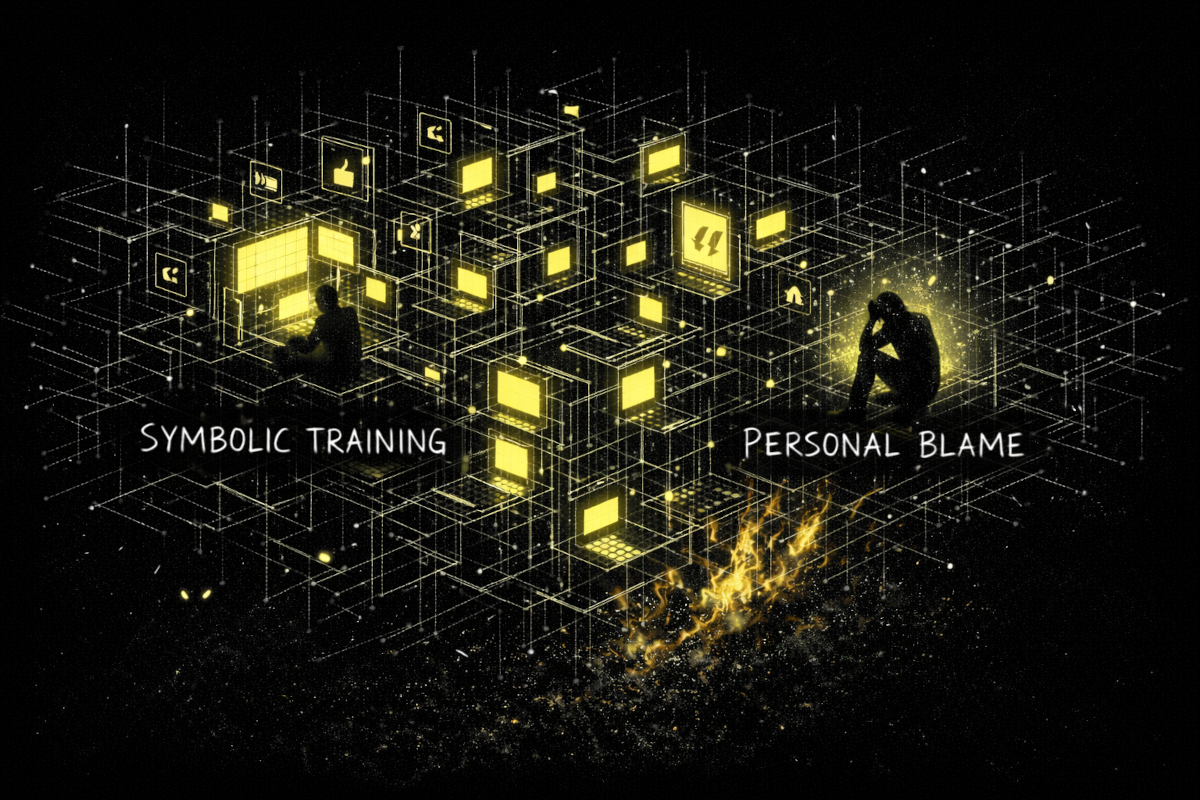
How old patterns of capture run through modern interfaces
Some songs age into nostalgia. Others age into diagnosis.
When Rusty Cage (Soundgarden, Chris Cornell) came out, it didn’t sound like a manifesto. It sounded like a body trying to move inside something it couldn’t name yet. Wired awake. Hit with broken nails. Tied to a lead and pulled by a chain. The cage wasn’t spectacular. It was rusted into normality. Old metal. Old bars. Inherited constraints you don’t remember choosing. What that song named somatically decades ago is what many are now learning to name structurally.
“Burning diesel, burning dinosaur bones” lands differently now. It reads like an accidental metaphor for the present moment: living nervous systems powered by dead fuel. Old patterns of extraction, control, and domination routed through newer and more powerful machines. Not just energetically, but psychologically and culturally. Ancient logics of capture piped through modern interfaces—platforms, algorithms, financial abstraction, AI.
The fork isn’t technology versus humanity. It’s whether old cages get scaled by new tools.
The cage in the song isn’t a prison tower. It’s infrastructure. It’s the background condition you live inside long enough that it feels like air. The urge to “break my rusty cage and run” isn’t utopian escape. It’s the organism’s reflex to reclaim movement, agency, and breath inside a system metabolizing the wrong kind of energy for living beings.
That’s the continuity:
The ache is old. The language is new. The machinery has changed.
That song named the ache long before I had the language for the architecture behind it.
The problem isn’t new. The interface is.
Modern systems govern by fragmenting body, meaning, and relation, shaping attention and trauma into compliance. This produces self-doubt and alienation, yet coherence remains possible wherever attention is reclaimed and human integration is repaired.
Modern power operates less through overt coercion than through fragmentation: severing embodied knowing, abstracting meaning into mediated authority, and sorting human bonds into managed divisions. These dynamics harden living traditions into institutional shells, normalize trauma as structural output, and train attention through symbolic capture. As attention is shaped, identity and behavior follow, producing alienation and self-doubt that are then misread as personal failure.
Yet beneath saturation and noise, a persistent human drive toward reintegration remains. Even under conditions of trauma, propaganda, and institutional pressure, coherence can re-emerge where attention sovereignty is restored and the bonds between body, meaning, and relation are repaired. This possibility does not promise redemption; it marks a grounded capacity for human integration that persists despite capture.
I used to think power looked like force. Armies. Laws. The visible weight of authority pressing down. But the longer I watched, the clearer the pattern became: modern systems rarely dominate humans by open coercion. They dominate by fragmentation.
The split begins in the body. Lived sensation becomes something to override. Fatigue is framed as weakness. Intuition is treated as unreliable. The body becomes an instrument to be optimized rather than a source of knowing. What once grounded perception is quietly trained to be ignored.
From there the fracture moves into meaning. What once felt intimate and alive—truth, God, purpose, conscience—is abstracted into doctrine, policy, or distant authority. Meaning becomes something administered. Something mediated. Something you are told about rather than something you are allowed to encounter.
And finally, the fracture settles into relationships. Human bonds are sorted into tribes, identities, and managed differences. Coordination gives way to lateral conflict. Suspicion replaces solidarity. People learn to argue with each other inside the lanes drawn for them, while the structures that drew the lanes remain untouched.
Over time, what begins as a living current—of truth, of healing, of meaning—hardens into institutional shell. The symbols remain. The language remains. But the life that once moved through them thins out. What once oriented humans toward coherence becomes a technology of compliance. The same book can wake one room into aliveness and press another into obedience. The same ritual can open a heart in one place and train submission in another.
In such environments, trauma is not a tragic anomaly. It is structural. Systems built for obedience, legibility, extraction, and scale reliably wound the nervous system. Injured humans learn to doubt their own perception. They learn to outsource truth to authority. They learn, quietly and repeatedly, to interpret systemic harm as personal failure. Fear becomes a tool of governance. Shame becomes the regulator that lives inside the chest. Fragmented people are easier to manage than regulated ones.
This is why attention becomes the true battleground. Ritual and advertising, ideology and platforms, propaganda and “magic” all run on the same engine. What you attend to becomes what stands out. What stands out becomes what feels real. What feels real becomes who you become. Most humans are being symbolically trained all day long without consent, then blamed for the shape of the selves that emerge from that training.
And yet, beneath the noise, something older persists.
Across mystic texts and therapy rooms, pop songs and prayer journals, late-night despair and quiet longing, the same ache leaks through. I want to be whole. I want to remember. I want to be seen without the mask. I want this to mean something. Institutions step in front of that ache and call themselves the answer. But the ache predates every institution. It is the body’s ancient pull toward re-integration.
Humanity is not stupid. It is overloaded and subtly gaslit. People sense that the stories don’t add up, that something in the system is off, that life has become thinner than it should be. But they are drowned in noise, trained to mistrust intuition, taught to pathologize pattern-recognition, and nudged to doubt themselves instead of questioning the structures shaping their lives. So recognition remains private—a quiet dissonance carried alone instead of becoming shared language.
This moment is not a smooth awakening. It is a fork. Multiple meaning-systems are losing legitimacy at once, and the old stories no longer organize reality the way they once did. Technology accelerates the stakes, capable of deepening capture or enabling new forms of sovereignty, depending on who governs the interfaces and incentives. Under this pressure, humans diverge in how they metabolize uncertainty. Some move toward coherence, regulation, and truth. Others retreat into armor, projection, sedation, and spectacle. This is not a moral sorting. It is adaptation under stress.
Still, the conditioning is not total.
Even amid trauma, propaganda, institutional terror, and symbolic capture, humans can remember what feels sacred. They can build real things with their hands. They can care for real people. They can choose truth over comfort and live with quiet integrity in ordinary ways. This is not heroic myth. It is evidence that coherence remains possible.
Humans are terrifyingly sacred creatures who have been convinced they are trash. Every system that dehumanizes depends on that lie. Everything worth doing begins with helping humans remember they are not disposable, not broken beyond repair, not insane for sensing the cracks.
The work is simple and hard. To name the pattern without turning it into a performance. To point at the cage without becoming a new cage. To refuse the lie that comfort is more important than truth. To reclaim sovereignty over attention. To repair the bonds between body, meaning, and relation. To keep language alive in places where silence and shame would prefer numbness.
Awareness keeps leaking through. Not because any system permits it. But because human coherence, when not fully captured, remembers itself.
Once again, thank you Chris.
Further Reading
Selected works exploring perception, framing, attention, and emotional conditioning.
Soundgarden. “Rusty Cage” (1991).
A somatic articulation of constraint and the drive toward regained agency.
Arendt, Hannah. The Origins of Totalitarianism (1951).
On how atomization and isolation enable modern systems of control.
Debord, Guy. The Society of the Spectacle (1967).
Analyzes mediation, representation, and the abstraction of lived experience.
Foucault, Michel. Discipline and Punish (1975).
Examines how modern power operates through normalization and internalized regulation.
Han, Byung-Chul. Psychopolitics (2014).
Explores self-optimization and voluntary submission in digital capitalism.
Lefebvre, Henri. The Production of Space (1974).
On how environments and infrastructures shape perception and relation.
Porges, Stephen. The Polyvagal Theory (2011).
Details how nervous-system states shape perception, safety, and social engagement.
Rosa, Hartmut. Social Acceleration (2013).
Connects systemic tempo to alienation and loss of resonance.