The Room That Went Silent
Modern life doesn’t filter for talent. It filters for nervous systems that can survive uncertainty and being unseen. When silence feels like failure, creation becomes survival. What looks personal is often a mismatch between human biology and systemic tempo.
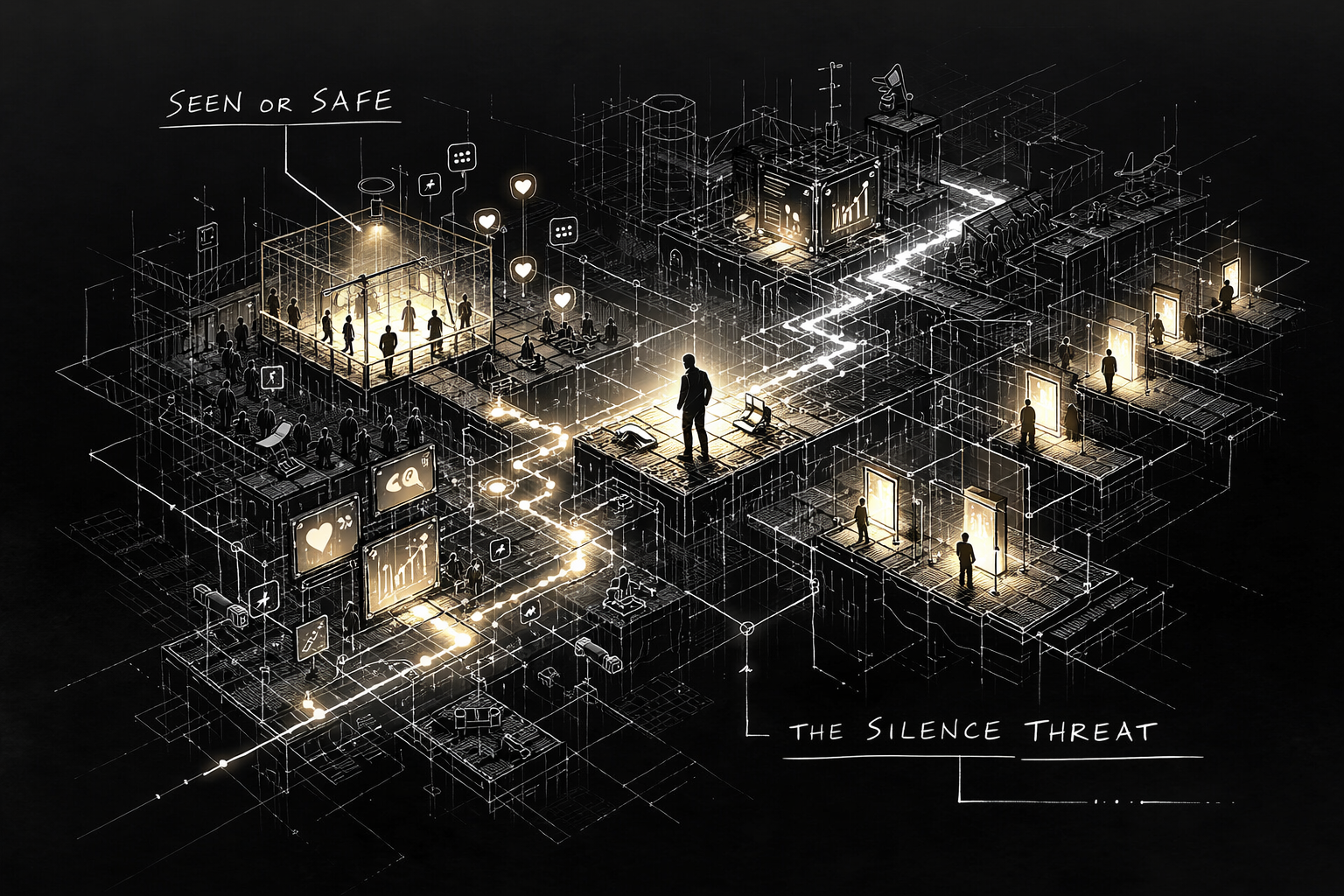
Why Modern Life Feels Like a Performance You’re Losing
A producer once observed that most artists do not fail because they lack talent. They fail because their nervous system cannot survive the conditions in which talent must operate. The decisive variable is not exposure. It is whether the body can endure being unseen longer than expected.
The decisive variable isn’t how many people see your work; it’s whether your body can endure being unseen longer than you expected. When we speak, post, or work and hear nothing back, we don't just feel "ignored." Biologically, we feel threatened.
To our ancient survival brain, being "unseen" by the tribe was a death sentence. Today, that same brain is plugged into a world where we are "unseen" by default unless we are performing.
The Continuous Audition
We used to think of "auditions" as something for actors or musicians. But today, everyone is on a stage. Whether you are updating your LinkedIn profile, waiting for the "read" receipt on a sensitive text, or sitting through a corporate performance review, you are in a state of continuous evaluation. We have turned existence into a broadcast.
The problem isn't the technology; it’s the regulatory margin.
- The Theory: Modern systems expand opportunity.
- The Reality: Modern systems shrink your ability to stay calm.
When every act is judged by a metric—a like, a comment, a quarterly KPI—your nervous system shifts from "creative mode" to "survival mode." You stop wondering "Is this good?" and start wondering "Am I safe?"
The Productivity Trap: Tools vs. Fuel
There is a profound difference between being Productive and being Generative.
- Productivity is the tool. It’s the repeatable output. It’s the "to-do" list you crushed.
- Generativity is the fuel. It’s the internal spark that makes you want to create, solve, or connect in the first place.
Modern life rewards productivity because it can be measured. You can count emails; you can’t count the quiet moment of insight that leads to a breakthrough.
The danger is that you can be highly productive while your generativity is dying. You can meet every deadline while feeling a hollow, "frozen" sensation in your chest. This isn't a lack of discipline; its biological exhaustion. The tool has started to consume the fuel.
The "Internet Speed" vs. Human Time
Our bodies have a natural tempo. We need "latency"—the quiet gaps where nothing is happening. But modern systems have compressed time. We expect instant feedback.
When that feedback doesn't come immediately, we interpret the silence as failure.
"If it didn't happen today, it’s never going to happen."
This "Temporal Compression" puts us in a state of chronic high alert. We are trying to run a human nervous system at the speed of a fiber-optic cable. The result isn't "efficiency"; it’s a Self-Trust Collapse. We stop trusting our own pace and start fearing the clock.
The Refuge: Low-Evaluation Creation
If you feel like you are "burning out," you might actually just be "judged out." When the pressure of being seen becomes too high, the smartest thing your body can do is withdraw.
This isn't a lack of ambition. It’s a protective recalibration.
To survive, we need "Refuges"—spaces where the evaluation is zero.
- The private journal no one will ever read.
- The hobby you are intentionally "bad" at.
- The project you work on anonymously.
These aren't distractions from your "real work." They are the only places where your generativity can breathe without being suffocated by a metric. They are the "Low-Evaluation" zones where you remember who you are when no one is watching.
A Structural Truth
If you feel anxious, blocked, or "less than," stop looking at your character and start looking at the architecture around you.
- You are not fragile. You are a biological organism being asked to process an astronomical amount of judgment in real-time.
- The silence isn't a sign of insignificance. It is a necessary part of a long-horizon life.
- Your worth is not a metric. The moment you see the system for what it is—a stress filter designed for machines, not people—the narrative of your own inadequacy begins to dissolve.
You aren't failing the test; you’re simply realizing that the test was never designed for a human heart.
Further Reading
Selected works exploring perception, framing, attention, and emotional conditioning.
Baumeister, Roy F., & Leary, Mark R. “The Need to Belong” (1995).
Foundational research on belonging as a primary human motivation.
Han, Byung-Chul. The Burnout Society (2010).
Explores internalized performance pressure and self-exploitation in achievement cultures.
Hochschild, Arlie Russell. The Managed Heart (1983).
Analyzes emotional labor and the commodification of affect.
Porges, Stephen. The Polyvagal Theory (2011).
Explains how perceived safety and threat regulate nervous-system states.
Rosa, Hartmut. Social Acceleration (2013).
Examines temporal compression and the shrinking of experiential margins.
Turkle, Sherry. Alone Together (2011).
Investigates digital visibility, connection, and the paradox of social exposure.
Winnicott, D. W. “The Capacity to Be Alone” (1958).
Argues that psychological health includes the ability to exist without evaluation.