The Persistent Dream of Free Energy
Why the idea of unlimited energy survives every failure — and what its persistence reveals about human hope, scarcity, and the gap between intuition and physical reality.
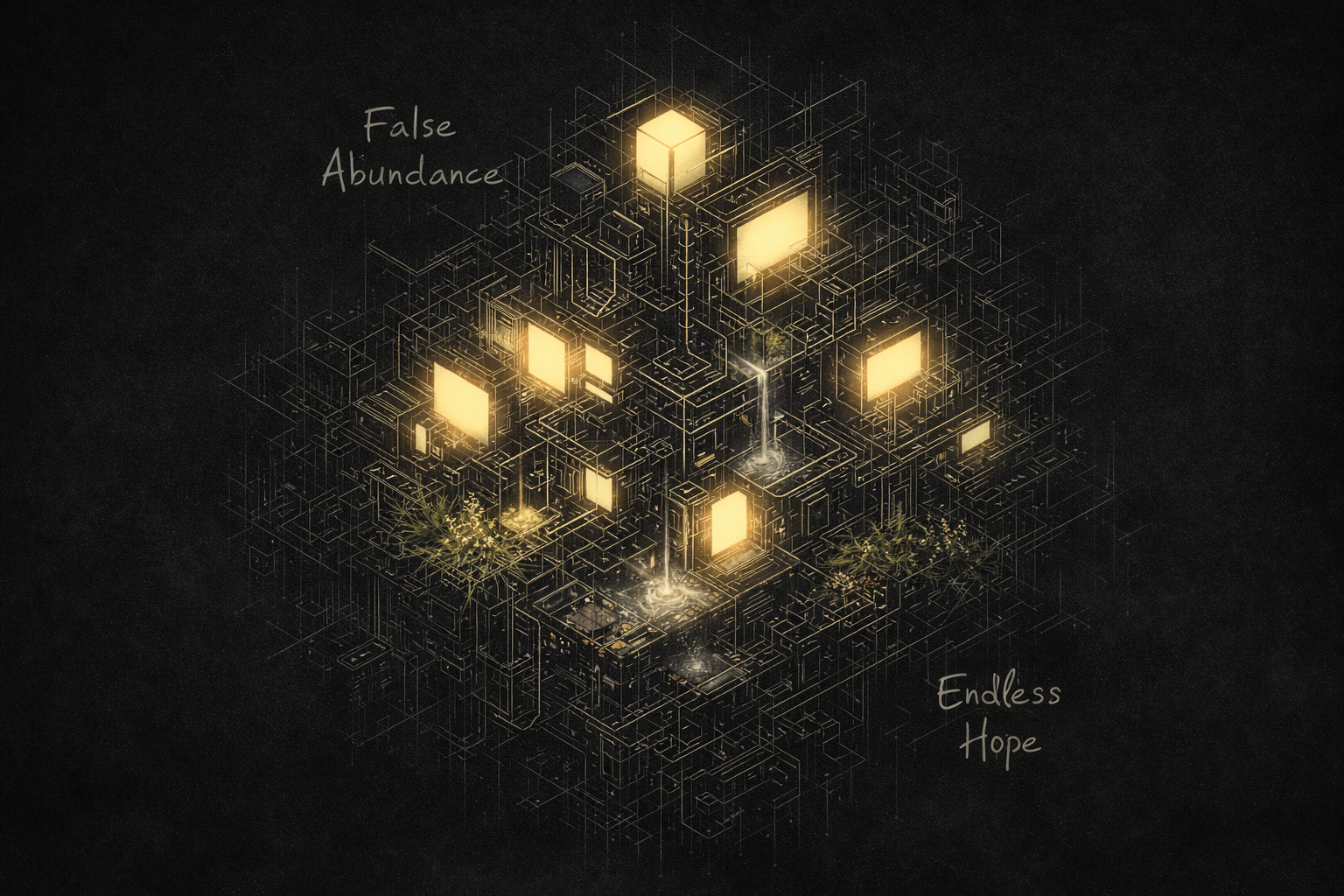
The Promise That Refuses to Die
Few ideas return with the same endurance as the promise of free energy. It reappears in every generation under new language: radiant power, zero-point extraction, ambient harvesting, cosmic electricity. Each version carries the same emotional undertone, that civilization stands on the edge of liberation, restrained only by ignorance or suppression. The promise is not merely technical. It is moral.
If energy were free, abundance would follow. If abundance followed, conflict would soften. Scarcity, the oldest antagonist of human organization, would finally loosen its grip. This is why the idea persists even when devices fail. The longing precedes the physics.
The confusion begins with something visually undeniable: the world never stops moving. Wind flows. Water cycles. The planet spins. Charged particles stream invisibly through space. Fields extend across continents. Lightning strikes endlessly. The cosmos vibrates with activity.
To the untutored eye, motion appears synonymous with energy. And energy, intuitively, appears synonymous with availability. Yet motion alone performs no work.
A river may flow endlessly without lifting a stone. An electric field may span kilometers without powering a lamp. A vibration may persist while transferring nothing of use. What matters is not movement, but difference. Without a gradient — without direction, imbalance, and asymmetry — motion remains inert. It exists, but it cannot be spent. This distinction is subtle. And it is almost never spoken aloud.
Much of the confusion surrounding energy arises not from physics, but from words. Energy becomes conflated with presence. Density with output. Resonance with generation. Continuity with infinity. These slippages accumulate quietly until meaning collapses.
A field that exists everywhere is assumed to be endlessly available. A process that continues indefinitely is assumed to be inexhaustible. A system that oscillates is assumed to be producing. None of these equivalences hold. Yet language allows them to coexist, unchallenged, in the same sentence. This linguistic drift is the birthplace of most free-energy narratives.
Nikola Tesla stands at the center of this confusion not because he was wrong, but because he lived between vocabularies.
He worked at a time when electromagnetic fields were newly understood, when resonance was mysterious, and when thermodynamics had not yet hardened into everyday intuition. His descriptions were expansive. His metaphors electrical. His imagination structural rather than statistical.
Tesla spoke of drawing energy from the environment — and he meant fields, gradients, and coupling. Later audiences heard creation. He demonstrated resonance — and observers inferred amplification of supply rather than efficiency of transfer. He described a universe saturated with energy — and readers assumed accessibility. What he lacked was not insight, but the language to fence insight from fantasy.
History filled the gaps.
The most dangerous word in energy discourse is 'everywhere'. If energy exists 'everywhere', it feels irrational that it cannot be used anywhere.
This intuition is emotionally compelling — and physically false. Oxygen exists everywhere, yet cannot burn without structure. Heat exists everywhere, yet cannot perform work at equilibrium. Pressure exists everywhere, yet does nothing without difference.
The universe contains immense quantities of energy locked into symmetrical states. Their very stability is what makes the universe coherent. Breaking that symmetry requires cost. No mechanism escapes this exchange.
The idea of free energy is rarely born from ignorance of science. It is born from exhaustion with systems.
Energy markets feel unjust. Infrastructure appears centralized. Power grids mirror political power. The dream of effortless generation becomes a proxy for independence. In this environment, physics becomes symbolic.
Constraints are recast as control. Conservation becomes censorship. Entropy becomes conspiracy. The problem is not curiosity, it is that moral frustration is projected onto physical law. Nature becomes accused of withholding what it never offered.
There are, in fact, continuous energy processes surrounding us. Electrical potentials persist between sky and ground. Thermal gradients pulse between earth and air. Radiation passes silently through walls. Magnetic fields sweep the planet.
These phenomena are real. They are also weakly coupled, low in power density, and bounded by symmetry. They do not vanish. They simply do not scale. Their contribution is persistence, not abundance. They sustain. but they do not supply.
The misunderstanding endures because it sits at the intersection of three human blind spots:
– intuition evolved for visible mechanics, not fields
– language that collapses technical distinctions
– moral longing projected onto physical systems
Each reinforces the other.
When expectation exceeds structure, disappointment seeks explanation. When explanation is absent, mythology enters. Free energy survives not because it works, but because it comforts.
Once the structure is recognized, something unexpected happens. The universe does not appear stingy. It appears ordered. Energy is not scarce but access is conditional. Motion is not absent but leverage is constrained. Fields are not empty but coupling is selective. Nothing is hidden. Nothing is forbidden. Nothing is free.
The question is no longer whether energy surrounds us, but under what conditions it becomes usable. This neither diminishes wonder nor promises liberation. It replaces hope-without-form with clarity-with-boundaries. What remains is not disappointment, but coherence.
Every era produces its myths at the edge of its vocabulary. When science advances faster than language, imagination rushes in to bridge the gap. The dream of free energy is therefor not foolish, it is premature. Until boundaries are named, intuition will continue to mistake presence for permission.
Clarity begins not with new machines,
but with seeing what the universe is (and is not) offering.
Further Reading
Selected works exploring perception, framing, attention, and emotional conditioning.
Bateson, Gregory. Mind and Nature (1979).
On pattern, difference, and the informational role of gradients.
Feynman, Richard P. The Feynman Lectures on Physics, Vol. I (1963).
Clear exposition of energy, work, and conservation without metaphysical drift.
Kahneman, Daniel. Thinking, Fast and Slow (2011).
Explains intuitive misreadings of probability, scale, and physical constraint.
Kuhn, Thomas S. The Structure of Scientific Revolutions (1962).
On vocabulary shifts and conceptual discontinuities in scientific change.
Latour, Bruno. Science in Action (1987).
Explores how technical language stabilizes or destabilizes public understanding.
Prigogine, Ilya. From Being to Becoming (1980).
Examines order, symmetry, and the thermodynamic conditions of change.
Smil, Vaclav. Energy and Civilization: A History (2017).
Connects energy density, infrastructure, and societal structure.
Weber, Max. The Protestant Ethic and the Spirit of Capitalism (1905).
On how moral frustration and economic structure shape belief systems.