The Mirror Is Not the World
When reality begins to feel hostile, chaotic, or unresponsive, the world is often blamed. But what may be shaping experience is not the world itself, but the mirror through which it is met. The task is not to escape reality, but to learn to see the lens that meets it.
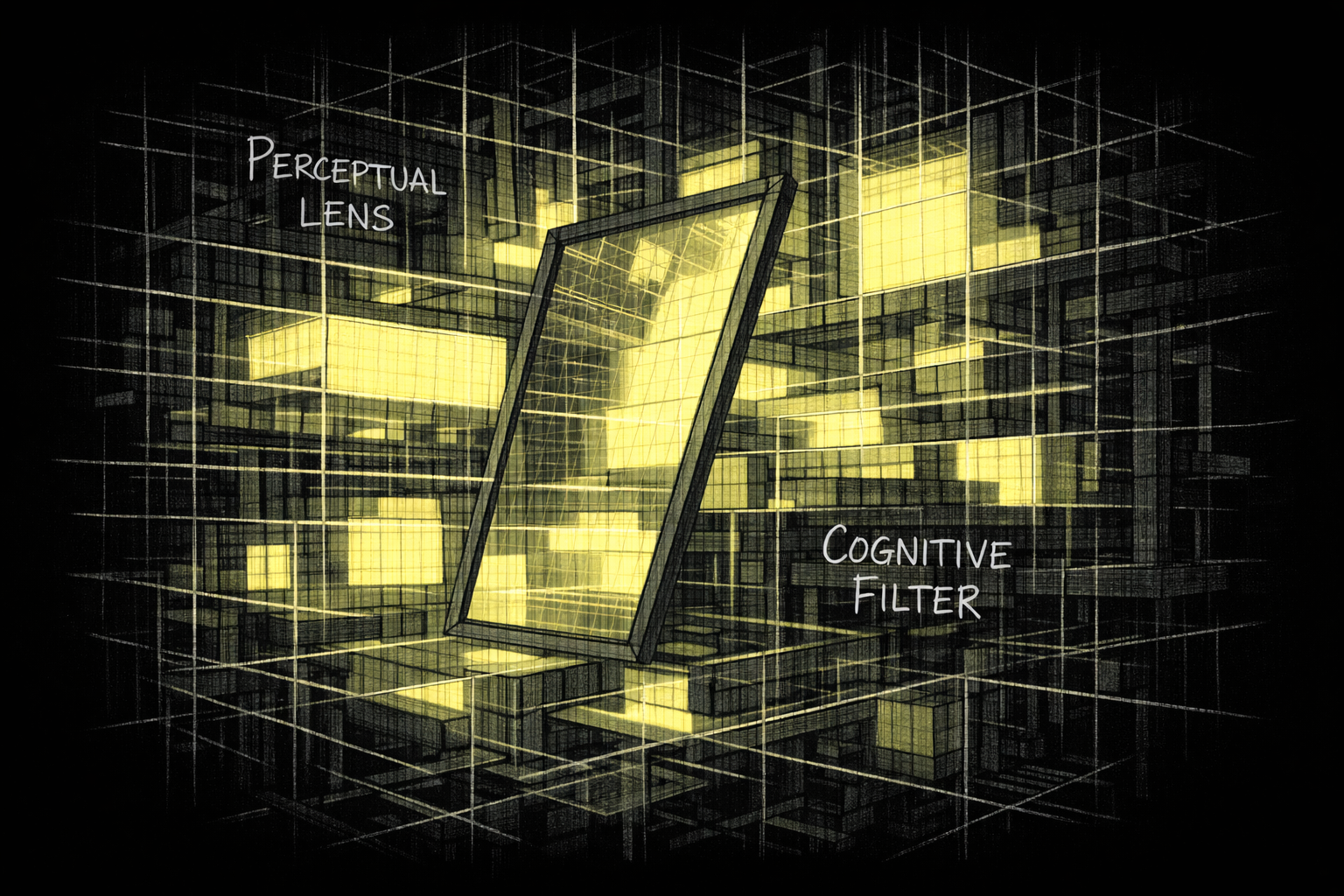
At a certain point in sustained reflection on perception, something subtle begins to shift. The tension that once felt external—“they are shaping reality”—starts to be experienced differently. Not as accusation, but as unease. A sense that one’s own seeing is no longer entirely one’s own.
This is the moment the environment becomes the mirror.
Language, time, institutions, symbols, and emotional climates do not remain outside the individual. They do not merely surround perception. Over time, they become the lenses through which perception itself occurs. What once shaped experience from the outside becomes the structure of experience from within.
The mirror is not an object, it is the habitual configuration of seeing.
When the field that surrounds a person is patterned by fragmented time, compressed language, normalized authority, symbolic reflex, and emotional saturation, the experience of the world begins to take on those same qualities. The world feels hurried because attention has learned fragmentation. The world feels compressed because language has learned enclosure. The world feels volatile because emotion has learned to remain activated.
Reality does not change. the mirror does.
This is not a philosophical abstraction. It is an experiential consequence. The individual wakes into a world that feels crowded. Moves through a day that feels compressed. Encounters others through frames already loaded with tone. Carries emotion that feels larger than any one moment. Agency begins to feel distant, abstract, deferred. Meaning feels outsourced. The world appears unresponsive. Not because the world is only distortion, but because the mirror through which it is met has never been allowed to clear.
At this point, the original language of “they” often dissolves into something more intimate. The sense of manipulation becomes less about external actors and more about internal pressure. One’s own reactions feel pre-scripted. Attention feels pulled before choice arrives. Emotion rises before understanding stabilizes. The world feels authored elsewhere, even when no author can be named. This is the lived effect of internalized architecture and the tragedy here is not deception. It is misattribution.
Hostility is located in reality rather than in the lens through which reality is encountered. Chaos is attributed to events rather than to the tempo of attention. Unresponsiveness is located in others rather than in the reflexive frames through which others are met. The mirror remains invisible, and so its angle is mistaken for the shape of things.
Agency feels abstract because it is being sought in the wrong place. Meaning feels outsourced because the apparatus of meaning has been externalized. This does not make the individual wrong, it makes the conditioning complete.
When the mirror is internalized, it becomes self-sealing. It reflects the world in the tones it has learned to hold. It confirms its own orientation by what it allows into view. The environment persists inside the individual long after any particular message, institution, or stimulus has passed. The architecture remains active as habit. The field lives on as orientation.
To recognize the mirror is not to deny the world’s constraints, it is to restore the distinction between world and lens.
When that distinction returns, experience begins to reconfigure. The world does not become gentle. Difficulty does not dissolve. Complexity does not recede. What changes is the quality of contact. Events regain dimensionality. Others regain opacity. One’s own reactions regain context.
The mirror does not become perfect, it becomes legible.
And in that legibility, authorship quietly returns—not as mastery over reality, but as participation in how reality is met. The individual does not step outside the world. The individual steps back into the scene of perception with a renewed capacity to discern where the world ends and the mirror begins.
This is not yet exit. It is integration.
But without this moment of legibility, exit becomes fantasy. One cannot redirect a mirror one has never seen. The work begins when the mirror is no longer mistaken for the world.
Excerpt from The Hijacking of the Mirror
Further Reading
Selected works exploring perception, framing, attention, and emotional conditioning.
Barrett, Lisa Feldman. How Emotions Are Made (2017).
Argues that emotions are constructed through learned conceptual and cultural frameworks.
Clark, Andy. Surfing Uncertainty (2016).
Explores predictive processing and how internal models shape perceived reality.
Crary, Jonathan. 24/7: Late Capitalism and the Ends of Sleep (2013).
Examines continuous activation and the erosion of natural temporal rhythms.
Foucault, Michel. The Archaeology of Knowledge (1969).
Analyzes how institutional discourses structure what can be said and perceived.
Goffman, Erving. Frame Analysis (1974).
Describes how interpretive frames organize social experience and meaning.
Han, Byung-Chul. The Burnout Society (2010).
Explores internalized performance pressure and emotional overactivation in modernity.
Lakoff, George. Don’t Think of an Elephant! (2004).
Demonstrates how linguistic framing shapes political and moral cognition.
Seth, Anil. Being You (2021).
Explains perception as a controlled construction of the brain rather than passive reception.