Obedience Is Not Morality
Obedience promises clarity without inner struggle, but when morality is reduced to what can be measured and enforced, conscience is quietly displaced by procedure. Order increases, meaning things. The risk is that compliance replaces formation and ethics becomes administration.
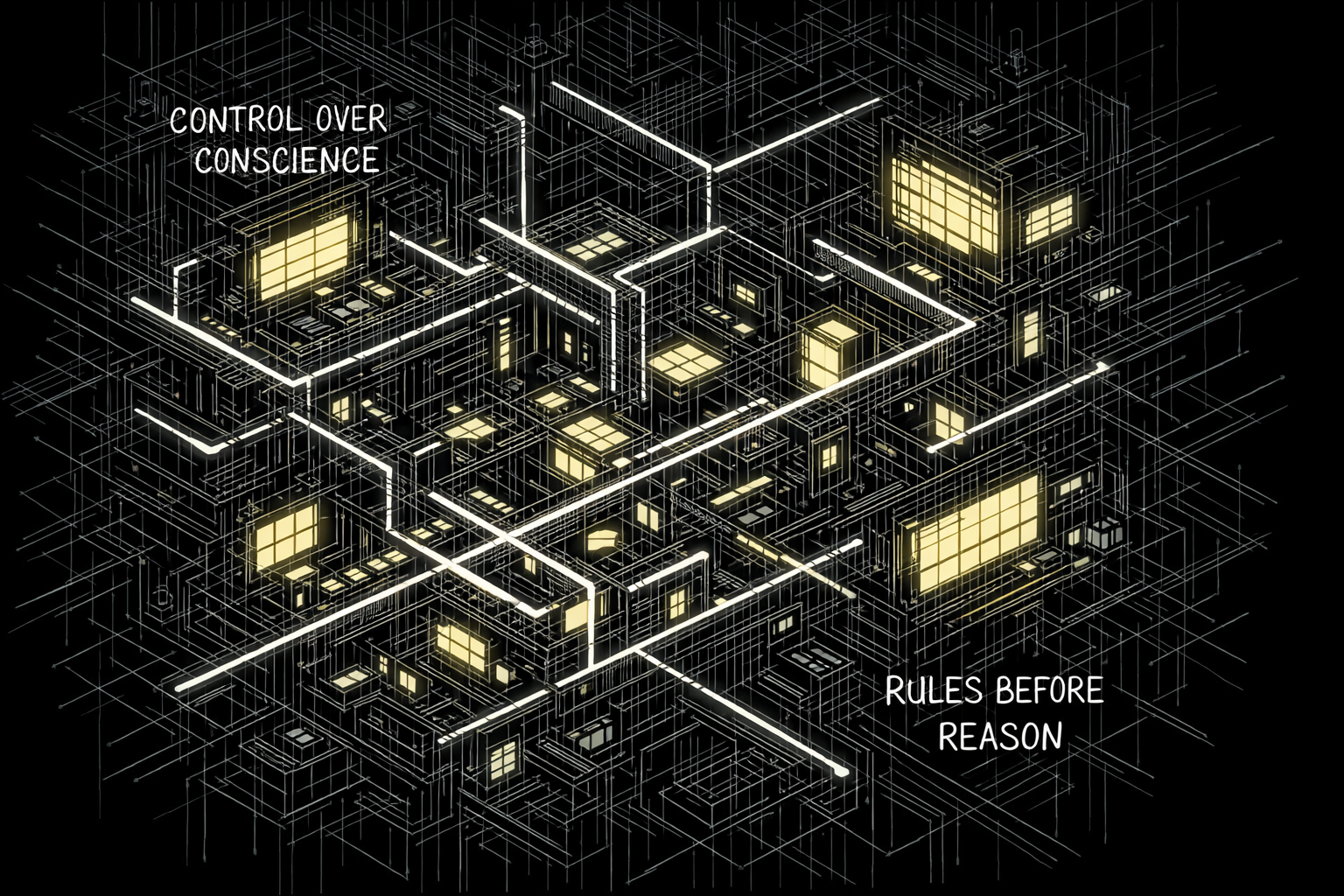
How Formation Was Replaced by Compliance
There is a certain comfort in clean lines: clear thresholds of right and wrong:
- Permitted versus forbidden.
- Compliant versus non-compliant.
- Policy followed or policy breached.
From the outside, such systems appear refreshingly rational, even ethical. No ambiguity. No messy psychology. No interior uncertainty. You either complied, or you did not.
In an age fatigued by complexity, this reduction feels like realism. It promises order without inner struggle, clarity without self-examination. Morality, reimagined as administration. But what is being described here is not morality. It is governance.
Across modern institutions, from corporate compliance regimes to procedural legalism, ethics has been quietly redefined as observable behavior. What cannot be recorded is discounted. What cannot be documented is dismissed. What cannot be audited is treated as unreliable.
The inner life comprised of intention, discernment, conscience, and perception is recast as a liability rather than a moral terrain. Complexity is framed as inefficiency. Interiority as noise.
This framing is seductive precisely because it promises relief from difficulty. It offers a way out of moral uncertainty. If ethics can be reduced to checklists and thresholds, then no one has to wrestle with the more fragile work of judgment. But complexity is not a cultural failure. And interiority is not an outdated superstition. They are the conditions of moral agency itself. To remove them is not to make ethics more realistic. It is to make it thinner.
The Seduction of Measurability
Modern systems increasingly operate on a single premise: what cannot be measured cannot be trusted. And so morality retreats to what can be counted. Trainings completed. Policies acknowledged. Certifications renewed. Violations logged.
Like prayers ticked off a checklist, ethical life becomes procedural. The shift is subtle. No one announces that conscience has been removed. It simply stops being consulted.
Instead of asking whether an action was taken in good faith, the system asks whether behavior aligned with policy. Instead of asking whether harm was intended, it asks whether harm was perceived. Instead of asking who someone is becoming, it asks whether they were observed crossing a boundary.
Without anyone quite deciding it, morality migrates from formation to compliance.
This migration feels responsible. It feels safer. It feels like progress. But it quietly transforms the purpose of ethics. The aim is no longer to cultivate discernment, but to minimize liability. The aim is no longer to shape character, but to standardize outcomes. Moral life is flattened into administrative legibility.
Interior alignment is difficult. It cannot be standardized. It cannot be scaled. It cannot be enforced without destroying the freedom that gives it meaning.
Large systems cannot tolerate moral ambiguity; they require predictability. And predictability demands substitution. Conscience is replaced by procedure. Judgment by protocol. Understanding by enforcement.
What is lost is not disorder, but depth.
The result is not ethical clarity, but ethical minimalism: a system no longer concerned with who someone becomes, only with what can be administratively held against them.
When the Inner Life Becomes Inconvenient
Once interiority is treated as unreliable, it becomes inconvenient. Intention complicates cases. Context destabilizes rules. Discernment resists automation. So the inner life is not attacked. It is simply bypassed. Moral language remains, but it floats free of moral formation.
People learn to speak ethically long before they learn to see ethically.
Under such conditions, performance replaces alignment. People learn what to say, what not to write, which phrases trigger flags, which acknowledgments offer immunity. Agreement replaces comprehension. Compliance replaces belief. Optics replace ethics. The institution becomes increasingly orderly and increasingly hollow—immaculately governed, existentially confused.
This is not hypocrisy in the old moral sense. It is adaptation. The system rewards visible conformity, not interior clarity. So people conform visibly. The system cannot distinguish learning from submission, care from signaling, harm from misunderstanding. Everything looks identical under audit. Order increases. Meaning evaporates.
What cannot be enforced ceases to matter:
- Understanding becomes irrelevant.
- Intention becomes suspicious.
- Silence becomes safety.
The Real Fracture
This logic is often misframed as a cultural or religious divide. But the fracture is not between sacred and secular worlds. It is between two fundamentally different moral logics: formation and management.
Formation asks who a person is becoming. Management asks whether procedures were followed. Formation requires interior alignment. Management requires documentation. One cultivates discernment. The other produces silence.
Obedience, in itself, is not the enemy. Every moral tradition recognizes the role of discipline. But obedience detached from perception becomes theater. Compliance detached from conscience becomes fear.
Systems built entirely on enforcement inevitably mistake order for goodness, because goodness cannot be compelled.
- Law can survive without interiority.
- Institutions can function.
- Stability can be maintained.
Morality cannot.
Morality is not the absence of violation. It is the presence of alignment. Not only of hands, but of intention. Not only of conduct, but of perception.
It concerns who a person becomes when no one is watching, not merely how they perform when they are.
No society, however regulated, can enforce its way into wisdom.
Editorial note
This essay continues the Cassian Bey series examining the fracture between moral formation and system logic. Where earlier pieces traced how fluent systems mistake coherence for truth, this installment shows how institutions mistake order for goodness—replacing interior alignment with procedural compliance. The throughline is structural: when governance displaces formation, ethics becomes legible but hollow.
Further Reading
Selected works exploring perception, framing, attention, and emotional conditioning.
Arendt, Hannah. Eichmann in Jerusalem (1963).
On administrative obedience and the banality of moral displacement.
Foucault, Michel. Discipline and Punish (1975).
Examines normalization, surveillance, and the production of compliant subjects.
Han, Byung-Chul. The Burnout Society (2010).
Analyzes performance culture and internalized system demands.
MacIntyre, Alasdair. After Virtue (1981).
Argues for moral formation over bureaucratic ethical minimalism.
Milgram, Stanley. Obedience to Authority (1974).
Empirical study of compliance under institutional pressure.
Packer, Martin J. The Science of Qualitative Research (2011).
On the irreducibility of interpretation and lived moral context.
Taylor, Charles. Sources of the Self (1989).
Explores the interior moral landscape and identity formation.
Weber, Max. Bureaucracy (1922, in Economy and Society).
Classic account of rational-legal authority and administrative logic.