AI as Cognitive Prosthesis in an Overstimulated Civilization
The digital revolution scaled human cognition faster than human biology. AI emerges as a cognitive prosthesis that stabilizes individuals within an accelerated system, yet it cannot renegotiate tempo. The unresolved tension lies not in intelligence, but in rhythm.
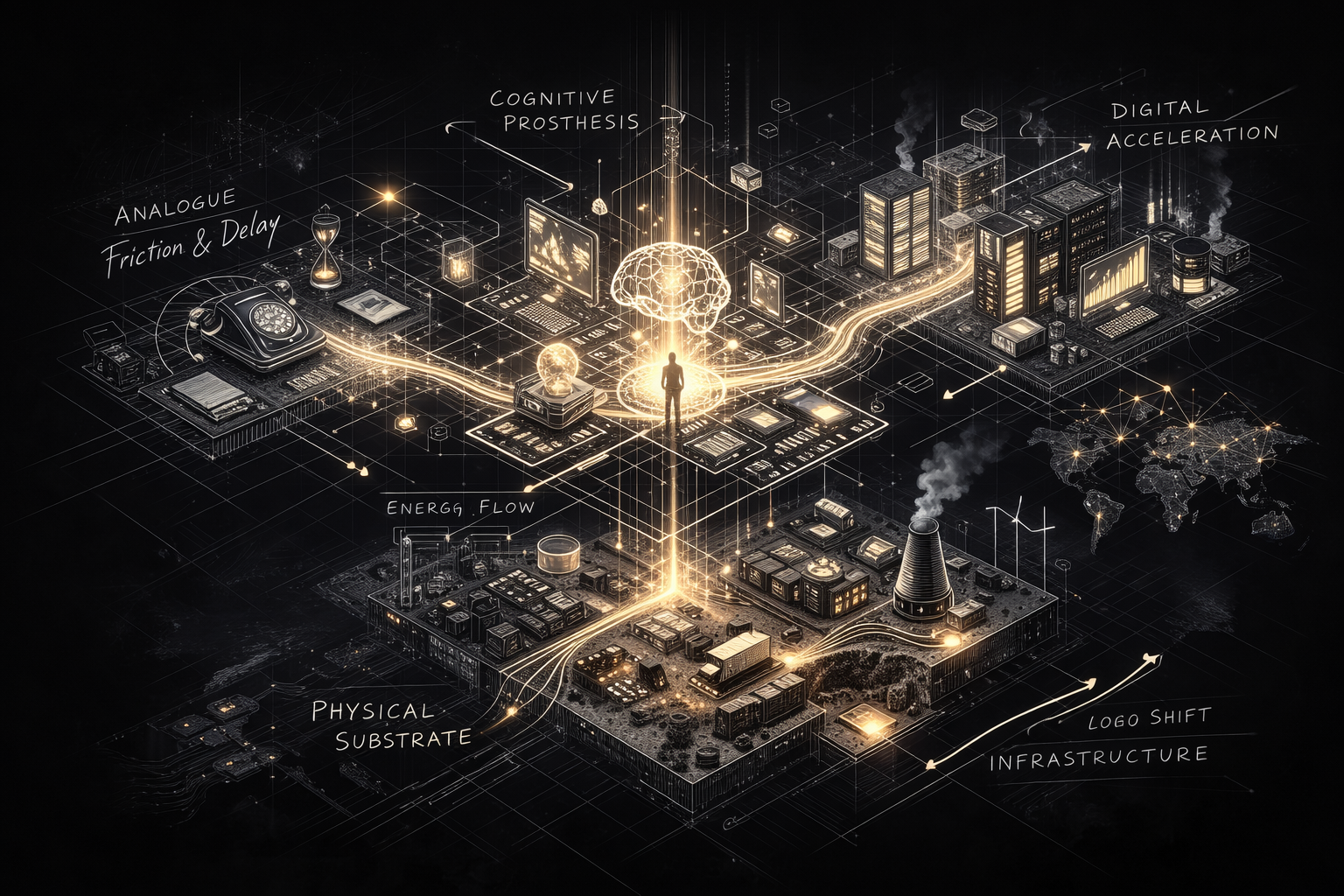
There was a time when delay had weight.
There was a time, not so long ago, when existence was anchored by the weight of a circular dial. To reach another person was a deliberate, mechanical act of patience. You memorized the sequences of numbers like a litany, and when the line was busy or the house was empty, you simply waited.
Since the mid-1990s, we have been living through what might be called the "Acceleration Event". In that era, being available twenty-four hours a day was the ultimate luxury, a service paid for dearly by those whose time was deemed essential. Today, the architecture of our lives has inverted. The luxury is no longer the ability to be reached; it is the rare, expensive permission to be silent, to be off the grid, to be uncoupled from the infinite stream. It is a luxury today not to be available, as we were before the ‘Acceleration Event’.
This public digital revolution of the mid-1990s did not merely connect us; it altered our tempo. What had once been periodic became continuous. Communication stopped arriving in intervals and began streaming without pause. Feedback cycles compressed. Visibility widened. The small circle of local recognition expanded into a potentially global audience.
Nothing dramatic occurred on any single day, and yet something structural shifted. The rhythm of life began to synchronize with machines.
Our cognitive capacities adapted quickly. We learned to scan, sort, and respond in a world of permanent connectivity. We built dashboards for our days. We moved between overlapping conversations without fully leaving any of them. We became capable of managing more information than any previous generation.
But the nervous system that carries that cognition did not evolve in thirty years. It evolved in environments of slower rhythm and limited social bandwidth. It evolved for cycles—effort and recovery, exposure and retreat.
The digital age scaled our minds before it scaled our biology.
What follows from that scaling is not merely faster cognition. It is a quiet internal reordering. As our capacity to analyze expands, so does our ability to reinterpret experience. High cognition confers framing power. We can model the incentives of the system, understand its metrics, and narrate our own exhaustion as evidence of adaptation. Strain becomes optimization. Fatigue is recast as temporary resistance. We remain capable of explaining what is happening to us, even as it happens.
And yet understanding is not the same as integration.
In a healthy hierarchy, the body signals and the mind interprets. Effort is followed by recovery. Exposure gives way to withdrawal. Tension is noticed before it hardens into injury. Regulation precedes continuation. There is a rhythm in which the organism participates, rather than one it must override.
Under accelerated conditions, that order begins to invert. The mind reframes before the body is heard. Signals of depletion are categorized as obstacles to solve rather than limits to respect. Behavior continues. Action stabilizes unease. Production becomes a form of regulation. Silence no longer feels like rhythm; it feels like inefficiency.
This is not a moral failure. It is a misalignment.
When cognition outruns regulation, friction does not vanish; it migrates inward. It appears as subtle tension in the jaw, a slight lift in the shoulders, breath that does not fully settle. A restlessness lingers beneath accomplishment. The organism attempts to keep pace with a cognitive layer that has already moved ahead, and in doing so it stretches beyond the cadence for which it was designed.
The nervous system was never built for continuous acceleration. It was built for pulses—intensity followed by restoration, alertness followed by release. When that pulse flattens into constant motion, something essential begins to strain, even if we possess the language to justify it.
We could process more, decide faster, and react sooner. As a result, regulatory margins quietly shrank. When iteration accelerates, expectation rises. When drafting becomes easier, more drafts are expected. When analysis can be automated, timelines contract. What was once impressive becomes baseline. What was once optional becomes required. Efficiency does not stabilize standards; it resets them. And when standards reset faster than recovery cycles, strain accumulates quietly.
This is the hidden inflation of acceleration. Each technological gain becomes tomorrow’s minimum. The system absorbs capability and converts it into expectation. The faster we can think, the more we are asked to think. The quicker we can respond, the less delay is tolerated. Acceleration becomes ambient.
In such environments, tempo ceases to feel like a choice. It becomes the background condition of participation. It is within this widening gap—between cognitive expansion and biological constancy—that artificial intelligence appears. Not as prophecy. Not as rupture. But as prosthesis.
A prosthesis does not replace the organism. It extends it. It compensates for a limitation so that movement can continue.
AI functions as a cognitive extension for an overstimulated civilization. It compresses patterns from volumes of data that would otherwise overwhelm attention. It filters streams that exceed our sorting capacity. It assists in decisions where variables multiply beyond intuitive grasp. It assumes routine cognitive labor so that the human mind can redirect its focus toward coordination, synthesis, or simply survival within the system.
AI does not emerge because humans lack intelligence. It emerges because intelligence alone cannot regulate tempo. We built tools to think faster. Now we build tools to survive the speed those very tools created. And yet the paradox remains.
By reducing friction locally, AI intensifies expectation systemically. When summarizing becomes instant, information expands to fill the available space. When analysis can be outsourced, strategic oversight becomes constant. The local relief of cognitive strain contributes to systemic speed.
AI stabilizes the individual within the machine, while the machine continues to accelerate.
The human organism feels this quietly. Shoulders lift slightly. Breath shortens. Attention fragments. We understand the metrics and can analyze the dashboards, but the body does not negotiate with abstraction. It responds to pace.
The deeper question is not whether AI is beneficial or dangerous. It is whether it is sufficient.
If AI becomes necessary for ordinary cognition—if filtering, summarizing, drafting, and deciding increasingly require prosthetic assistance—then perhaps the issue was never intelligence. Perhaps it was tempo.
AI may function as a temporary stabilizer within an overstimulated civilization. It allows the cognitive layer to continue operating under conditions that might otherwise overwhelm it. But stabilization at the level of thought does not automatically renegotiate the rhythm of life.
A prosthesis enables continuation. It does not redefine cadence.
At this point, another symmetry emerges.
Just as the human mind extends itself outward to compensate for biological strain, the digital layer itself possesses a physical body. Software appears abstract, gliding across screens without friction, but the systems that sustain this cognitive extension have mass. They require land, energy grids, cooling systems, manufacturing chains, rare earth minerals, and global logistics. Data centers hum. Heat must be dissipated. Infrastructure must be built and maintained.
The prosthesis has a metabolism, and that metabolism does not exist in abstraction. It lives in earth, water, metal, and heat.
When we relieve strain on our own nervous systems by outsourcing cognition to machines, the energy does not disappear. It moves. The burden shifts layers. What is light in the interface is heavy somewhere else.
This is not a critique. It is a structural echo.
Acceleration never floats. It settles somewhere.
The same pattern that exists between mind and body in the individual appears between software and hardware in civilization. Cognition scales rapidly. Infrastructure strains to support it. The individual experiences tension in posture and breath; the system experiences tension in grids and cooling capacity. In both cases, escalation in one domain requires compensation in another.
The question, then, is not whether we can build larger prostheses. We can. The question is whether we can live indefinitely at a tempo that requires them.
The digital revolution expanded what we could think and how quickly we could think it. It did not renegotiate the pace at which a human heart beats or a body recovers. In trying to cope with this discrepancy, we have extended ourselves outward into the machine. We have built cognitive exoskeletons to maintain participation in an environment that moves faster than our biology prefers.
AI may hold the system together for a time. It may compress noise into usable form. It may prevent collapse at the level of attention. But coherence does not arise from compression alone.
Coherence returns only when we stop treating our biology as a limitation to be bypassed and begin treating it as the ground upon which we actually exist.
The body does not accelerate to match the machine. It waits. And in that waiting, rhythm quietly reasserts itself.
Further Reading
Selected works exploring perception, framing, attention, and emotional conditioning.
Alter, Adam. Irresistible (2017).
Examines behavioral design and the mechanics of digital overstimulation.
Carr, Nicholas. The Shallows (2010).
Explores how internet-era media reshape attention and cognition.
Clark, Andy. Natural-Born Cyborgs (2003).
Argues that human cognition naturally extends through technological prosthesis.
Crary, Jonathan. 24/7: Late Capitalism and the Ends of Sleep (2013).
Analyzes continuous activation and the erosion of biological rhythm.
Han, Byung-Chul. The Burnout Society (2010).
Describes internalized performance pressure in acceleration cultures.
McLuhan, Marshall. Understanding Media (1964).
Introduces media as environments that restructure perception and tempo.
Porges, Stephen. The Polyvagal Theory (2011).
Explains nervous-system regulation under conditions of sustained activation.
Virilio, Paul. Speed and Politics (1977).
Explores acceleration as a structural force shaping modern systems.